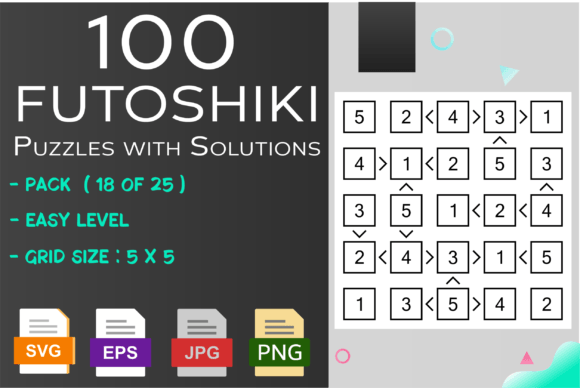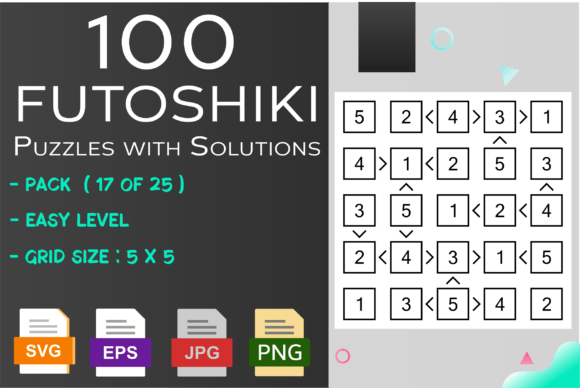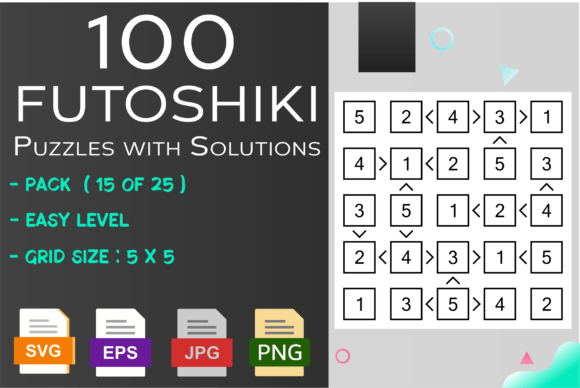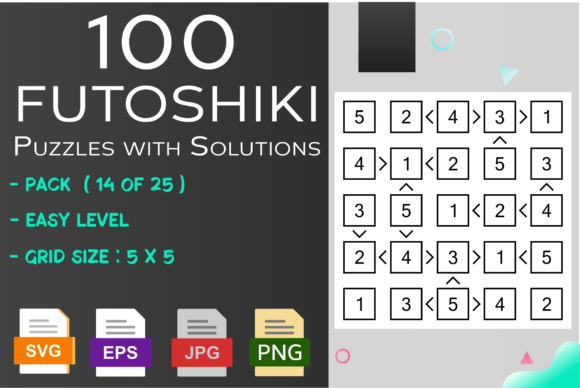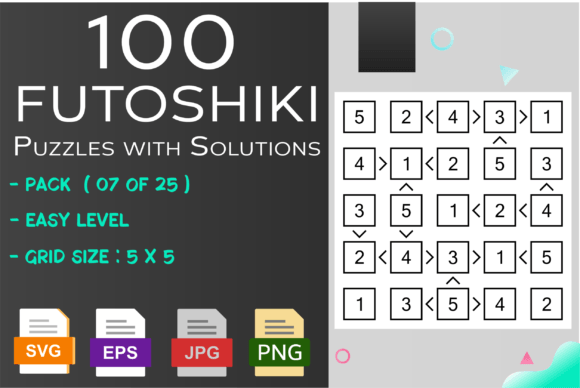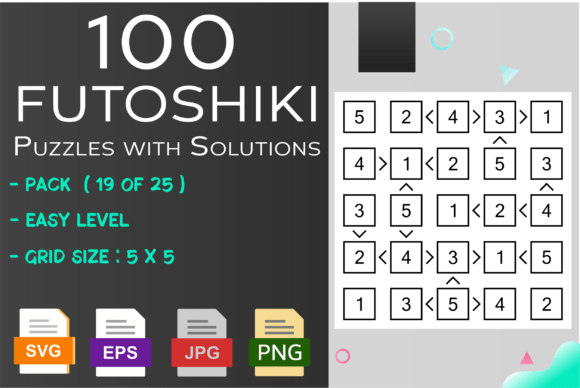
100 Futoshiki Puzzles Easy 19 of 25
If you've been hunting for clean, print-ready logic puzzles that slot effortlessly into your next KDP project, you've probably come across dozens of puzzle collections that overpromise and underdeliver. The 100 Futoshiki Puzzles Easy 19 of 25 bundle takes a refreshingly practical approach. These aren't just random number grids thrown together. Each puzzle sits on a 5×5 grid with inequality signs guiding the logical flow, and the difficulty stays firmly in the easy range — making them perfect for beginners, casual solvers, and anyone looking for a gentle mental warm-up rather than a headache-inducing slog.
What immediately stands out with this collection is the crisp, high-resolution formatting. The grid lines are sharp, the inequality symbols read cleanly at a glance, and there's no visual clutter to distract from the solving experience. When you're embedding puzzles into a book layout, fuzzy graphics can wreck the professionalism of your entire publication. These files come in EPS, PNG, JPG, and SVG formats, which means you get both vector-based precision and raster convenience in one download. That kind of flexibility matters when you're jumping between design tools like Adobe Illustrator, Canva, or Affinity Publisher.
The personality of these puzzles leans toward clean minimalism — there's a certain understated confidence in how the grids are presented. No decorative flourishes, no unnecessary embellishments, just pure logical structure. For a publisher, this is actually a significant advantage because it means the design assets blend into virtually any book template without fighting for attention. You can layer your own brand identity on top without the underlying puzzle graphics competing with your cover design, page borders, or typography choices.
Why Easy 5×5 Futoshiki Puzzles Connect With a Broader Audience
There's a common misconception that puzzle books need to skew difficult to retain buyers. In practice, many customers — especially in the adult activity book market — actively seek out easier puzzles they can complete during a coffee break, while commuting, or in the evening without needing to reference a solutions page every five minutes. The 100 Futoshiki Puzzles Easy 19 of 25 collection taps directly into that demand. The 5×5 grid size keeps the cognitive load manageable, and the inequality constraints provide just enough structure to make each solve satisfying without ever feeling trivial.
From a publishing perspective, this accessibility widens your potential audience considerably. You're not just selling to hardcore puzzle enthusiasts. You're reaching retirees looking for daily mental stimulation, students unwinding between study sessions, parents grabbing ten minutes of quiet focus, and office workers decompressing during lunch. That broader appeal translates into better reviews, lower return rates, and stronger word-of-mouth recommendations — all signals that Amazon's algorithm pays attention to.
The visual consistency across all one hundred puzzles also contributes to a polished reading experience. Each grid maintains identical spacing, identical symbol sizing, and identical alignment. When a reader flips through your book, they'll absorb that consistency subconsciously. It signals care and attention to detail, which elevates the perceived value of your entire publication. This is one area where many KDP publishers cut corners, and it's precisely where standing out becomes easiest.
Practical Design Integration for KDP Publishers
Having four file formats at your disposal might seem like overkill until you run into a real-world production scenario. The SVG and EPS files serve as your master assets — scale them to any dimension without pixelation, adjust stroke weights if needed, and integrate them into vector-based layouts. The PNG and JPG versions give you quick drag-and-drop convenience for raster-based workflows or preview mockups. If you're building a book interior in PowerPoint or Word (which many first-time publishers do), the PNG files slot in without any compatibility headaches.
One practical recommendation: if you're pairing these puzzles with instructional content or solving tips, consider using a clean sans serif font for your body text to complement the geometric clarity of the grids. Something like Open Sans, Lato, or Montserrat creates a cohesive visual language where the typography and the puzzle graphics feel like they belong in the same family. If your brand leans more traditional, a well-chosen serif font can add warmth without competing with the puzzle elements.
These design assets also work beyond traditional puzzle books. You can repurpose individual grids for social media graphics, email newsletter content, printable worksheets for educators, or even as bonus material in a larger activity bundle. The commercial licensing that comes with the collection means you're not restricted to a single project — build an entire product line around these puzzles if you want to.
Building Reader Trust Through Consistent Quality
Trust matters more than most new publishers realize. A reader who spots a misaligned grid, an inequality sign that's hard to read, or a puzzle that feels randomly generated rather than purposefully designed will quietly close the book and move on. They might not leave a bad review, but they won't come back for your next release either. The 100 Futoshiki Puzzles Easy 19 of 25 collection sidesteps these risks because the puzzles have been crafted with print production in mind from the start.
When your book's interior maintains flawless visual hierarchy — puzzle grids that are clearly the focal point, solution pages that are easy to navigate, consistent margins and spacing throughout — readers develop an implicit trust in your brand. They start associating your name with reliability. Over time, that trust compounds. A customer who enjoyed your easy Futoshiki book is far more likely to try your medium-difficulty Sudoku collection or your word search compilation next.
Consider also the role of editorial design principles here. The puzzles themselves function almost like typography — they're structured blocks of visual information that need to breathe on the page. Giving each grid adequate white space, keeping solution sections clearly separated, and maintaining a logical flow from puzzle to puzzle creates a rhythm that keeps readers engaged. These aren't abstract design theories; they're practical decisions that directly impact how long someone spends with your book and whether they recommend it to friends.
Customization Possibilities Without Quality Compromise
One of the more underappreciated aspects of this collection is how easily it accepts customization. Because the source files are clean and uncluttered, you can add themed decorations, seasonal borders, or challenge badges around the grids without the result looking visually chaotic. A Christmas-themed puzzle book, a summer travel edition, a mindfulness and logic combination — these are all realistic spin-off products you can build using the same core assets.
If you're experimenting with font pairing for your book's title page or chapter headers, try matching a display font with personality against the geometric simplicity of the puzzle grids. The contrast between an expressive headline typeface and the structured, logical puzzle beneath creates visual interest that draws browsers toward the "Look Inside" preview on Amazon. That preview is often the deciding factor between a click and a scroll-past.
The puzzle size — a compact 5×5 grid — also leaves plenty of room on each page for supplementary content. You could include a brief historical note about Futoshiki's origins, a quick strategy tip, or even a motivational quote. This transforms a standard puzzle book into something with more texture and rereadability, which again feeds into better customer retention and review quality.
Making Informed Decisions About Your Puzzle Book Project
Before committing to any puzzle collection for a KDP project, it's worth testing a few things. Print a sample page with one of the PNG files at your intended trim size. Check that the line weight holds up at the final dimensions and that the inequality symbols remain crisp rather than breaking down. Run the solutions page through the same test — nothing frustrates a reader more than a solutions grid that's harder to decipher than the puzzle itself.
Also consider your book's overall structure. One hundred puzzles gives you flexibility in how you sequence the content. You might group them into chapters of twenty, add a progress tracker, or intersperse the puzzles with blank notes pages. The 100 Futoshiki Puzzles Easy 19 of 25 collection doesn't lock you into a single format, which means you can tailor the final product to your specific audience's preferences rather than forcing a generic layout.
From a licensing standpoint, always verify that the commercial terms align with your intended use. These files are positioned for KDP publishing specifically, which removes the guesswork that comes with sourcing puzzles from less specialized marketplaces where usage rights can be ambiguous or restrictively limited. Clear licensing protects both your current project and any future derivative works you might want to explore.
What ultimately sets this collection apart isn't any single feature in isolation — it's the combination of clean visual execution, multi-format flexibility, accessible difficulty level, and genuine KDP-ready practicality. For publishers who want to create puzzle books that earn repeat customers rather than one-off sales, having dependable, high-quality design assets as your foundation makes every subsequent creative decision easier and more confident.