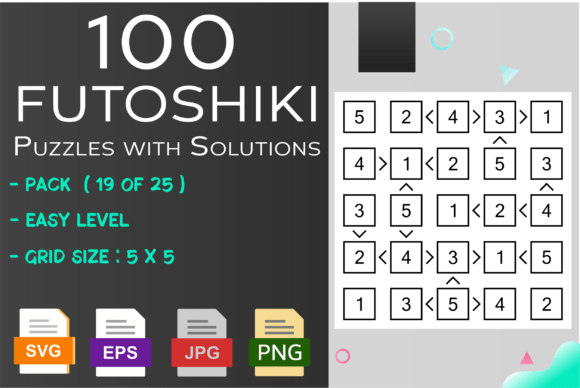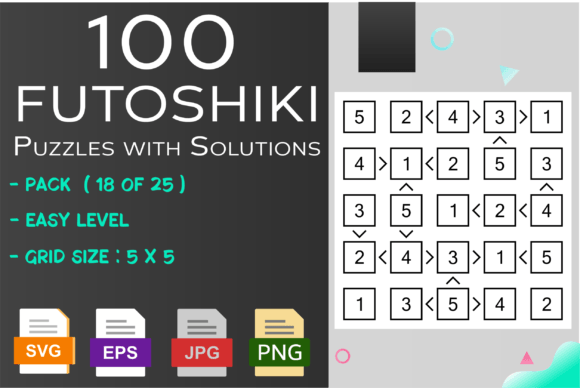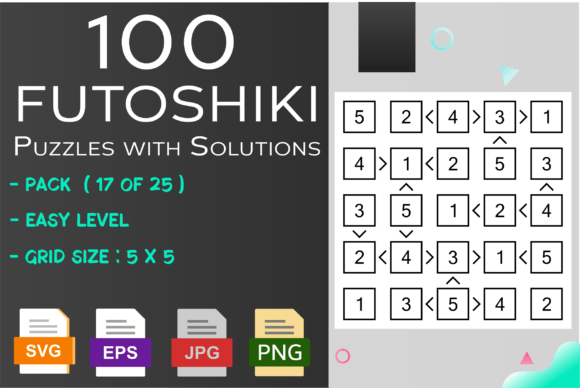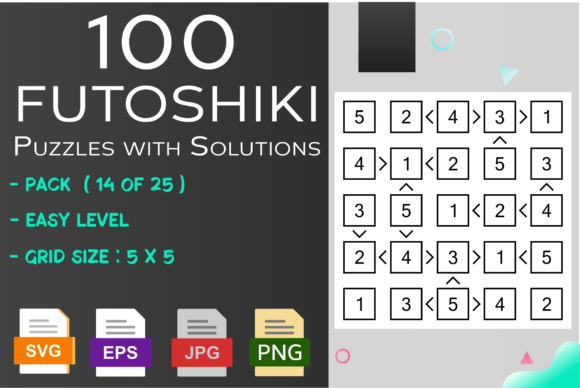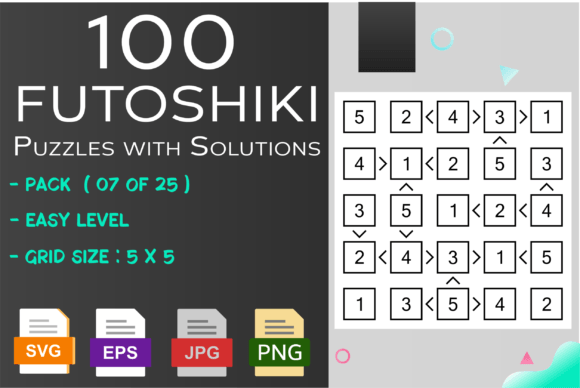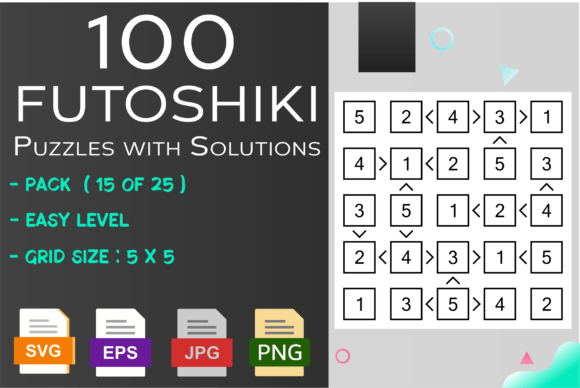
100 Futoshiki Puzzles Easy 15 of 25
There's something quietly satisfying about a well-designed logic puzzle. Not the kind that makes you want to flip the table after twenty minutes of dead ends, but the kind that gives your brain just enough resistance to feel rewarding. That's where the 100 Futoshiki Puzzles Easy 15 of 25 collection lands — squarely in the sweet spot between accessible and stimulating. If you've ever paged through a puzzle book and felt disappointed by grids that looked crammed in as an afterthought, you'll appreciate what makes this set different.
Futoshiki, sometimes called Unequal or More or Less, is a Japanese logic puzzle played on a square grid. The objective is straightforward: fill each row and column with numbers without repeating, while respecting the inequality signs scattered throughout the grid. What separates a forgettable Futoshiki from one that people actually want to solve comes down to craftsmanship — the logical flow of the puzzle path, the clarity of the grid lines, and how the numbers sit on the page. This collection nails those details.
What Makes These Puzzles Feel Different
The 100 Futoshiki Puzzles Easy 15 of 25 set operates on a compact 5×5 grid, which might sound modest, but that constraint is precisely what makes it work for a broad audience. Each puzzle uses only the numbers 1 through 5, yet the inequality constraints create enough branching logic to keep solvers engaged without pushing them into frustration territory. I've worked with plenty of puzzle assets where the "easy" label felt dishonest — grids that required advanced chaining techniques or guess-and-check desperation. These aren't that. The difficulty rating holds true across all 100 puzzles, making the collection reliable for publishers who need consistency in their books.
Visually, the grids carry a clean modern typography sensibility. The number placement feels intentional rather than algorithmic, and the inequality symbols are crisp enough that you won't squint at a greater-than sign wondering if it's actually pointing the other direction. When you're preparing content for print — especially for KDP where customer reviews can hinge on production quality — those small legibility factors compound quickly.
Who Benefits From This Collection
KDP publishers sit at the obvious center of the target audience, but the usefulness stretches further than you might expect. Content creators running puzzle blogs or newsletter features can pull individual grids for recurring segments without building everything from scratch. Educators and workshop facilitators find Futoshiki useful for warm-up exercises or logic curriculum supplements — the 5×5 format fits neatly on a handout without dominating the page. Even hobbyists who enjoy solving more than constructing will get value from having a ready-made library that doesn't repeat the same logical patterns endlessly.
Small business owners in the gift and stationery space have another angle here. Printable puzzle sheets bundled with other products, or used as packaging inserts, give customers something unexpected — a tiny mental break tucked into their purchase. The fact that the 100 Futoshiki Puzzles Easy 15 of 25 files arrive in four formats means you're not locked into a single workflow. EPS preserves vector quality for scaling. PNG and JPG handle quick placement in documents or social media previews. SVG plays nicely with modern design software and web integration. Each format solves a different practical problem, and having all four eliminates the usual format-conversion friction.
Designing Puzzle Books That People Actually Finish
Abandonment is the quiet killer of puzzle books. Someone buys a book, works through six or seven puzzles, hits one that feels unfair or tedious, and the book migrates to the back of a shelf. Keeping solvers in the flow means controlling difficulty gradients and ensuring the solving experience feels coherent from page to page. The 100 Futoshiki Puzzles Easy 15 of 25 collection maintains that coherence — all puzzles share the same difficulty band, so readers know what they're signing up for each time they turn the page.
From a brand identity standpoint, consistency matters just as much as the puzzles themselves. When you build a series of puzzle books, readers develop expectations about formatting, spacing, and visual rhythm. If your Futoshiki grids suddenly shift in style or quality mid-book, it registers — maybe not consciously, but enough to erode trust. Using a unified set of design assets across your entire project keeps the experience polished. The grid lines in this collection maintain uniform weight, the number typeface stays consistent, and the inequality symbols don't drift in size or positioning from puzzle to puzzle.
I've seen publishers underestimate how much typographic consistency influences perceived professionalism. The numbers inside these grids function almost like a display font — they need to be instantly readable at a glance while fitting the overall aesthetic of the page. Pair that number style with your body text choices carefully. A clean sans serif font for instructions and headers tends to complement the geometric nature of Futoshiki grids better than overly ornate alternatives. If you're going for a more traditional puzzle-book feel, a restrained serif font can work, but test it at print size first — serifs that look elegant at heading scale sometimes muddy at 9-point captions.
Practical Considerations for KDP Formatting
Amazon's print-on-demand infrastructure has specific requirements, and puzzle books introduce unique formatting challenges. Bleed settings, margin calculations, and image resolution all interact differently when your pages contain dense grid graphics rather than flowing text. The high-resolution dimensions of the 100 Futoshiki Puzzles Easy 15 of 25 files give you headroom — you can scale grids to fit your trim size without worrying about pixelation creeping into the inequality symbols. That's a real problem with lower-quality puzzle assets, and it's the kind of thing customers notice when a less-than sign looks like a smudge.
The EPS and SVG formats deserve particular attention if you're working with professional layout software like Adobe InDesign or Affinity Publisher. Vector files let you resize grids without degradation, and more importantly, they let you adjust stroke weights if you need to fine-tune how the grid lines print on different paper stocks. Uncoated paper absorbs ink differently than coated stock, and that subtle adjustment can make the difference between a grid that prints with crisp definition and one that feels slightly heavy or light.
Customization and Creative Control
One of the frustrations with pre-made puzzle collections is feeling boxed into someone else's design choices. The 100 Futoshiki Puzzles Easy 15 of 25 set takes a less prescriptive approach. You're not locked into a specific layout template or forced to include decorative elements that clash with your book's visual direction. Want to add a subtle background pattern behind the grids? The PNG files with transparency support make layering straightforward. Need to recolor the grid lines to match a brand palette? Vector formats give you that flexibility without rebuilding anything from scratch.
This matters for editorial design projects where the puzzle book needs to feel like a cohesive product rather than a collection of downloaded assets stitched together. Publishers who invest time in logo design and cover aesthetics for their KDP catalog shouldn't have the interior pages undermine that effort. Every element on the page — from the puzzle grid to the footer text — contributes to the overall impression of quality. When the grid itself looks considered and professionally produced, it elevates everything around it.
The commercial font conversation shifts slightly when we talk about puzzle assets rather than typefaces, but the underlying principle is similar: you need clear licensing terms that don't restrict how you use what you've purchased. The 100 Futoshiki Puzzles Easy 15 of 25 collection is built for commercial KDP use, so you can incorporate the puzzles into books you sell without navigating complicated attribution requirements or usage caps.
Beyond the Book Format
While KDP publishing drives most of the demand for puzzle collections like this, the usage scenarios branch out in interesting directions once you start thinking laterally. Social media graphics featuring a single puzzle — maybe a daily challenge posted to Instagram stories or Facebook — create engagement touchpoints that feed back into book sales. A clean 5×5 grid fits naturally into square and vertical formats without requiring awkward cropping. The SVG format handles responsive web display cleanly, so embedding a puzzle on a blog or landing page doesn't introduce the blurriness that often plagues raster images stretched to fill container widths.
Web design applications extend to puzzle membership sites, online learning platforms, or digital download shops where customers solve interactively or print at home. Having vector source files means you can adapt the visual treatment to match your site's design language without the puzzles looking like they were imported from a different aesthetic universe. That kind of font pairing awareness — matching the number style to your site's typographic system — separates professional-looking implementations from amateur ones.
Why Consistency Across 100 Puzzles Matters
Building a puzzle book from scratch means either constructing puzzles yourself (time-intensive and requiring a solid understanding of logic puzzle design principles) or sourcing them from multiple places (risking inconsistency). A single collection of 100 puzzles solves both problems. The logical voice stays uniform — you won't get sudden spikes in difficulty that frustrate readers who signed up for "easy." The visual presentation stays uniform too. Every grid uses the same line weights, the same number sizing, and the same spacing conventions.
That uniformity also makes your production workflow faster. Import once, set your master page templates, and flow the puzzles through. Compare that to receiving files from three different sources, each with its own margin assumptions, resolution differences, and format quirks — the time savings compound across a full book layout.
For the end user working through the puzzles, that consistency creates a rhythm. They develop a feel for how the inequality chains tend to resolve, what patterns emerge in a well-constructed 5×5 grid, and how to approach the solve efficiently. That doesn't mean the puzzles feel repetitive — the 100 100 Futoshiki Puzzles Easy 15 of 25 grids vary enough in their constraint placement to keep the solving experience fresh — but the underlying quality floor stays high enough that trust builds between the solver and the book.
Getting the Most From the Collection
If you're new to puzzle-book publishing, start by printing a few test pages on your home printer before uploading to KDP. Check how the grids look at actual size on paper similar to what your book will use. Pay attention to the inequality symbols at smaller sizes — the 5×5 format keeps everything generous enough that readability shouldn't be an issue, but your specific trim size and margin choices will affect the final in-hand experience.
Consider offering a sample puzzle as a lead magnet — a single-page PDF with two or three grids that potential buyers can download from your author site or social bio link. It's low-friction and gives people a chance to experience the puzzle quality before committing to a purchase. The 100 Futoshiki Puzzles Easy 15 of 25 collection gives you plenty of material to work with for promotional purposes without depleting the book's core content.
When you're ready to expand your catalog, having worked with a consistent puzzle set makes it easier to identify what your audience responds to. Maybe easy Futoshiki sells well enough that a medium-difficulty follow-up makes sense. Maybe the 5×5 format gets requests for larger grids. The data you gather from this first book informs smarter decisions about where to invest your publishing energy next. Starting with well-crafted design assets gives you one less variable to troubleshoot along the way.