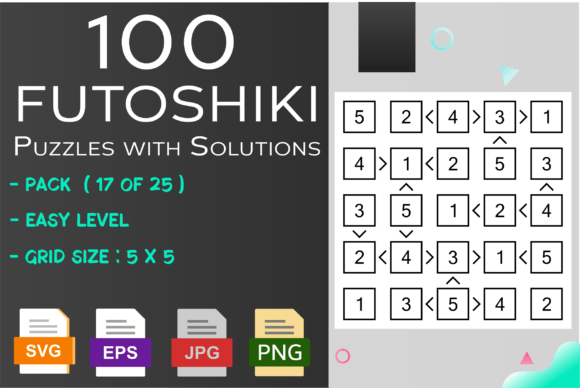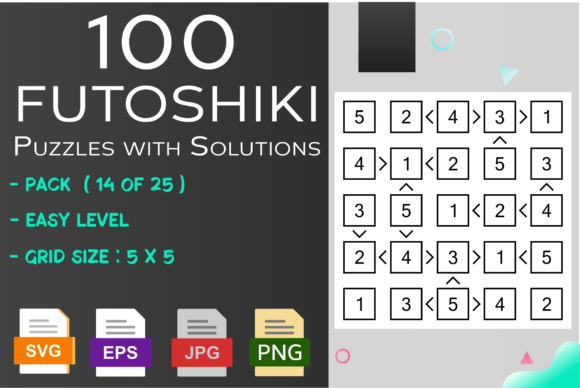
Unlocking Logic and Creativity with the 100 Futoshiki Puzzles Easy 14 of 25 Collection
Futoshiki, a logic puzzle with roots in Japanese puzzle culture, has steadily gained attention among brain game enthusiasts, educators, and independent publishers alike. The 100 Futoshiki Puzzles Easy 14 of 25 collection represents a thoughtfully assembled set that balances accessibility with genuine mental engagement. For anyone curious about how inequality-based grid puzzles function, or for those seeking high-quality content to incorporate into a publishing project, this collection offers a compelling entry point. The puzzles operate on a simple premise — fill a grid so that each row and column contains unique numbers, while respecting greater-than and less-than signs placed between certain cells. Yet within that simplicity lies a depth of logical reasoning that rewards careful thinking.
Understanding the Futoshiki Puzzle Mechanics
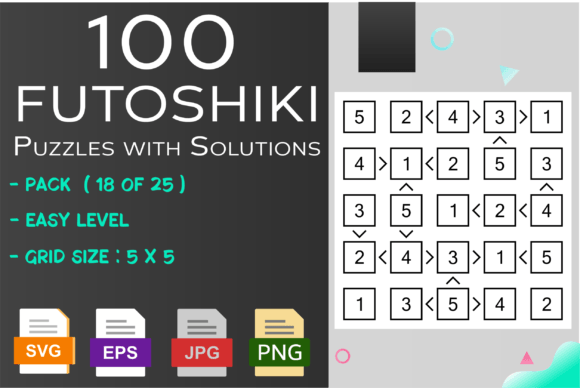
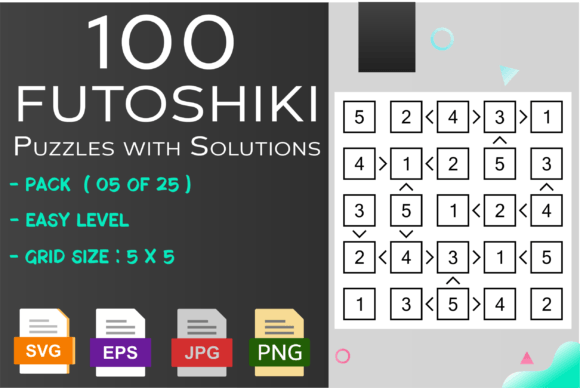
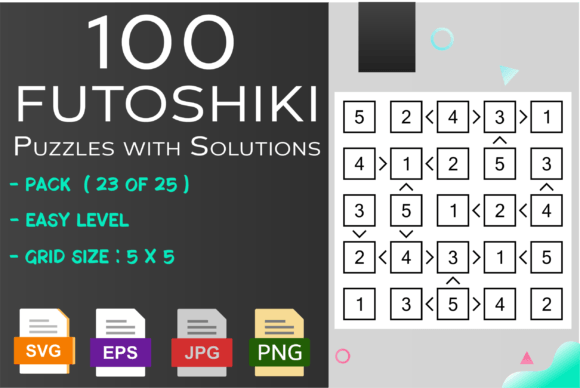
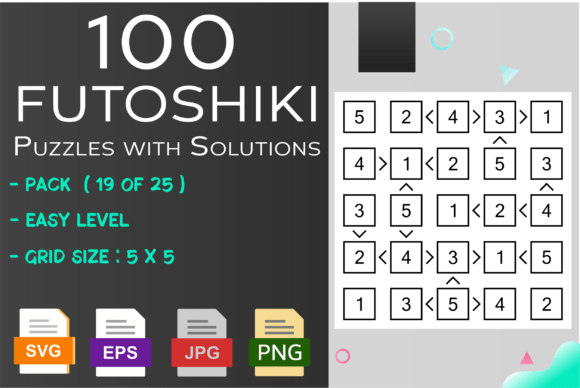
Unlike Sudoku, which relies solely on exclusion and placement logic, Futoshiki introduces comparative constraints that reshape how solvers approach the grid. In a standard 5x5 layout, numbers 1 through 5 appear exactly once in each row and column. The inequality symbols — the "greater than" and "less than" markers — create relational rules that must be honored. A cell marked with a symbol pointing toward a neighboring cell establishes a strict numerical hierarchy. This additional layer transforms the puzzle into a richer deductive experience. Solvers cannot simply scan for missing digits; they must also evaluate chains of inequalities that ripple across the grid. The 100 Futoshiki Puzzles Easy 14 of 25 set uses precisely this 5x5 format, keeping the complexity manageable while reinforcing core logical skills.
Why the 5x5 Grid Serves as an Ideal Starting Point
Grid size matters significantly in puzzle design. A 5x5 Futoshiki puzzle limits the numerical range to a narrow band, which reduces overwhelm for newcomers while still requiring methodical reasoning. The "Easy" designation in this collection indicates puzzles that avoid overly obscure deduction chains. Solvers can often make initial placements by identifying cells constrained by both row-column uniqueness and adjacent inequalities. For instance, if a cell sits between a "greater than" pointing left and a "less than" pointing right, the possible values narrow considerably. These gentle entry points build confidence. The 100 Futoshiki Puzzles Easy 14 of 25 set, positioned as the fourteenth installment in a broader series, maintains consistency in difficulty while varying the internal patterns enough to prevent monotony.
Cognitive Benefits Across Different Audiences
Logic puzzles like Futoshiki are not merely pastimes; they engage working memory, pattern recognition, and sequential reasoning. For older adults seeking to maintain cognitive sharpness, the inequality constraints in Futoshiki provide a different type of mental exercise than word-based puzzles or memory games. The brain must hold multiple relational rules in mind simultaneously — the uniqueness requirement for rows, the same for columns, and the directional inequalities that override both. Younger solvers, including middle school students, benefit from the structured yet creative thinking that Futoshiki demands. Teachers have observed that students who regularly engage with inequality puzzles develop stronger intuitions about numerical relationships and ordered sequences. The 100 Futoshiki Puzzles Easy 14 of 25 collection, with its graduated difficulty within the easy range, suits these varied users without alienating any group.
Practical Observations from Regular Solvers
Experienced puzzle solvers often note that Futoshiki feels more dynamic than Sudoku because the inequality symbols create visible pathways through the grid. A chain of symbols can act like a roadmap, guiding the solver from one deduction to the next. When a puzzle contains a long sequence of greater-than signs spanning multiple cells, the solver can often determine the maximum and minimum values for those positions immediately. This cascading effect makes the solving process feel progressive rather than stalled. The puzzles in this particular collection emphasize such visible chains, making them suitable for casual evening solving sessions or quick mental warm-ups during a commute. The solutions provided alongside each puzzle allow for immediate verification, which supports iterative learning — a solver who makes an error can trace back through the logic without prolonged frustration.
Publishing Potential for KDP Creators
For independent publishers using Kindle Direct Publishing, puzzle books represent a steady and evergreen category. The challenge lies in sourcing content that is both original and properly formatted. The 100 Futoshiki Puzzles Easy 14 of 25 collection addresses this by delivering puzzles in multiple file formats — EPS, PNG, JPG, and SVG. This variety ensures that publishers working with different software ecosystems can integrate the puzzles seamlessly. Adobe Illustrator users may prefer EPS for its vector precision, while Canva or Affinity Publisher users might opt for high-resolution PNG or JPG files. SVG files offer scalability without quality loss, which is essential for print projects that demand crisp lines at any dimension. The collection's KDP-ready nature means creators spend less time adjusting layouts and more time designing compelling book covers and interior structures.
Format Flexibility and Design Control
Each of the four included formats serves a distinct purpose within a publishing workflow. Vector formats like EPS and SVG allow for infinite resizing without pixelation, making them ideal for print-on-demand books where interior graphics must remain sharp across various trim sizes. Raster formats — PNG and JPG — provide convenience for quick previews, digital-only products, or integration into mixed-media projects. Publishers can extract individual puzzles, rearrange them into themed sections, or combine them with other puzzle types to create hybrid activity books. The high-resolution graphics mentioned in the product specifications ensure that even at larger print sizes, the grid lines and inequality symbols retain their clarity. This attention to output quality reflects an understanding of the practical demands faced by self-publishers who cannot afford reprints due to blurry interiors.
Customization as a Creative Asset
One of the standout aspects of working with a puzzle collection like this is the freedom to customize. Publishers are not locked into a rigid template. They can add introductory pages explaining Futoshiki rules in their own voice, insert motivational quotes between puzzle sections, or design answer keys that match their brand aesthetic. Some creators incorporate subtle thematic elements — coloring the inequality symbols to match a book's color palette, or adding decorative borders around each grid. The 100 Futoshiki Puzzles Easy 14 of 25 puzzles serve as raw material that sparks creative direction rather than dictating it. This flexibility extends to educators who might wish to print selected puzzles on worksheets, add instructional annotations, or embed them into larger lesson plans about logical reasoning and mathematical inequalities.
Educational Integration and Classroom Use
Teachers and tutors working with students on comparative reasoning find Futoshiki puzzles to be valuable tools. The puzzles translate abstract mathematical concepts — greater than, less than, ordering, deduction — into tangible, visually engaging challenges. A student who struggles with number lines or inequality notation may grasp the same ideas more readily when solving a Futoshiki grid. The visual placement of symbols between cells creates a spatial representation of numerical order that complements traditional instruction. The easy difficulty level of this collection ensures that students are not immediately discouraged, yet the puzzles still require genuine thought. An educator could distribute the first ten puzzles as warm-up activities, observe which students grasp the logic quickly, and then offer more challenging puzzles from later in the collection to those ready for advancement.
Quality Considerations for Long-Term Use
Puzzle collections intended for repeated use — whether in a published book or a personal solving journal — must maintain consistent quality. Grid alignment, symbol clarity, and solution accuracy are non-negotiable. The 100 Futoshiki Puzzles Easy 14 of 25 collection emphasizes high-resolution graphics suitable for sharp printing, which matters greatly when puzzles are reproduced in physical books. A misaligned inequality symbol could render a puzzle unsolvable or create unintended ambiguities. Similarly, the solutions must be error-free; even a single incorrect answer undermines trust in the entire collection. The compact file size mentioned in the product details suggests efficient organization without sacrificing detail, making the collection manageable for creators who handle multiple puzzle sets simultaneously. Publishers building a series of Futoshiki books can rely on consistent formatting across installments, which strengthens their brand identity.
Building a Cohesive Puzzle Book Brand
For KDP publishers aiming to establish a recognizable brand, consistency across puzzle collections is essential. Readers who enjoy one book will expect a similar experience in subsequent volumes. By using collections like this one — clearly labeled as part of a series with designations such as "14 of 25" — publishers can create a structured product line. They might release volumes sequentially, each containing 100 puzzles, and market them as a progressive difficulty series even when all puzzles remain within the easy range. The numerical labeling helps customers track which volumes they have completed and encourages repeat purchases. The inclusion of solutions in each collection further standardizes the product, meeting reader expectations for self-contained puzzle books that require no external resources.
Solving Strategies That Enhance the Experience
Newcomers to Futoshiki often benefit from a few foundational strategies that make the solving process more intuitive. The first involves scanning for extreme values — cells that, due to surrounding inequality symbols, can only contain the highest or lowest possible digit. In a 5x5 grid, if a cell has greater-than symbols pointing to all its neighbors, that cell must contain a 5. Conversely, a cell pointed to by neighboring greater-than symbols must be a 1. The second strategy leverages combined row and column scanning; a digit that appears constrained by inequalities in both its row and column often has only one viable placement. The puzzles in the 100 Futoshiki Puzzles Easy 14 of 25 set are designed to reward these techniques without requiring obscure advanced methods. This makes the collection suitable for solvers who are still internalizing the rhythm of inequality-based deduction.
Observations on Puzzle Variety Within the Set
Even within a single difficulty classification, puzzle variety matters. Some puzzles may feature dense clusters of inequality symbols that create tightly interconnected constraints. Others may have sparse symbols, leaving more cells open to standard Sudoku-like logic. The interplay between these styles keeps the solving experience fresh. A solver might breeze through a puzzle with abundant relational clues, only to slow down and think more carefully when faced with a grid containing fewer visible guides. This natural variation within the 100 Futoshiki Puzzles Easy 14 of 25 collection ensures that the set does not feel repetitive, which is a common pitfall in large puzzle compilations. The designers appear to have balanced symbol distribution to maintain engagement without escalating difficulty beyond the easy threshold.
Who Benefits Most from This Collection
The audience for Futoshiki puzzles spans multiple demographics, and this collection serves several of them effectively. Puzzle hobbyists looking for a relaxing yet stimulating activity will appreciate the accessible difficulty and the satisfaction of steady completion. Independent publishers gain a ready-to-use asset that reduces content creation time and supports print and digital formats alike. Educators and parents acquire a resource that reinforces logical thinking in an entertaining format. Seniors seeking cognitive engagement find puzzles that challenge without frustrating. The versatility of the collection stems from its dual nature — it is both a standalone solving experience and a raw creative material for those who build products around puzzles. The multiple file formats and the inclusion of solutions make this duality possible without compromise.
Long-Term Value and Reusability
Unlike consumable products that are used once and discarded, puzzle collections hold lasting value. A publisher can use the same puzzle set across multiple projects — a standalone Futoshiki book, a mixed puzzle compilation, a printable digital download, or a classroom worksheet bundle. The vector formats preserve quality through countless exports and resizes. For personal solvers, the digital files can be printed multiple times, shared among family members, or revisited after months to see if solving speed has improved. The 100 Futoshiki Puzzles Easy 14 of 25 set, with its compact storage footprint and broad format compatibility, aligns with both immediate and long-term use cases. This reusability factor distinguishes well-prepared puzzle collections from those that offer only a single, rigid presentation.
The enduring appeal of Futoshiki lies in its blend of simplicity and subtlety. A grid, a handful of numbers, and a scattering of inequality symbols combine to create an experience that is simultaneously calming and intellectually invigorating. The 100 Futoshiki Puzzles Easy 14 of 25 collection captures this balance, presenting puzzles that honor the solver's time while sharpening their deductive abilities. For publishers, educators, and enthusiasts alike, the set represents not just a product but a platform — a foundation upon which engaging books, effective lessons, and enjoyable pastimes can be built. The attention to format diversity, print quality, and puzzle consistency reflects a deep understanding of what makes puzzle content valuable in both personal and commercial contexts.