When Everything Feels Urgent: How a Task Triage List Printable Template Cuts Through the Noise
It’s Tuesday morning and your to-do list looks like a ransom note. There’s a half-finished client proposal, a reminder to schedule a dentist appointment, a sticky note about buying a birthday gift, and an email from your manager with “ASAP” in the subject line. Your brain isn’t sure where to land first, so it does what overwhelmed brains do — it scrolls social media instead. What’s missing isn’t motivation. It’s a system that separates what merely shouts from what actually matters. That’s exactly where a Task Triage List Printable Template earns its place on your desk.
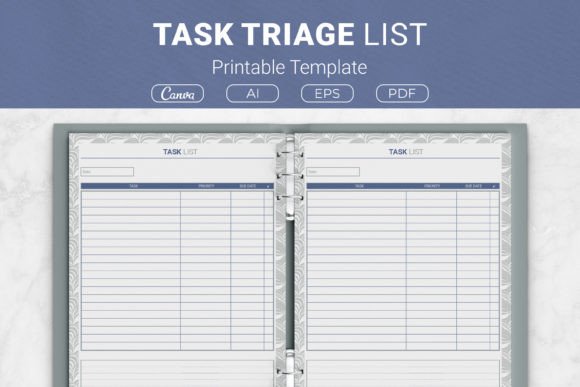
Unlike a flat checklist that treats buying milk and finalizing a quarterly report as equals, a triage template forces you to assign priority levels, due dates, and a clear order of attack. The word “triage” comes from emergency medicine, where resources are allocated based on severity, not arrival time. Applying that same logic to a workday sounds dramatic, but anyone who has ever spent three hours perfecting a slide deck while ignoring a time-sensitive contract knows it’s exactly that: a low-stakes task bleeding precious energy from a critical one. The printable template version gives you a physical, reusable canvas to make those judgment calls visible, often using columns for task name, urgency ranking, status, and deadline. Sizes like US Letter, A4, or the compact 6×9 inch format mean it fits into a home binder, a work clipboard, or a KDP planner interior just as comfortably.
The Freelancer Juggling Five Clients and Zero Structure
Freelancers live in a world where every email feels client-facing and every ping could be a lost gig. Without a manager or a team to set priorities, the day can quickly become reactive. One freelancer shared how she started each morning by opening her laptop and diving into whichever email screamed loudest. After a few weeks, her largest client gently asked why project timelines kept slipping. She hadn’t missed a single small ask from anyone else — she just never protected the deep work that mattered most.
Using a Task Triage List Printable Template let her batch tasks into three simple categories she borrowed from medical triage: red (immediate and high-stakes), yellow (important but can wait a few hours), and green (low-energy, fill-in tasks). She printed a fresh sheet each Monday morning, wrote down every open loop from her brain and inbox, then assigned a color. The rule was non-negotiable: no green tasks before all reds were done. The physical sheet sat next to her keyboard as a guiltless gatekeeper. If she felt tempted to proofread a LinkedIn post before finishing a client deliverable, the paper reminded her: that’s a green. It waits. Within two weeks, she’d cut her late deliverables to zero and noticed something unexpected — her stress dropped because the decisions were already made on paper, not re-litigated in her head a dozen times a day.
Project Managers, Product Launches, and the Mid-Sprint Shake-Up
Project managers often rely on digital boards and Gantt charts, but those tools assume a stable world. The moment a stakeholder reshuffles priorities mid-sprint or a critical bug appears twenty-four hours before a release, the tidy digital columns feel like wishful thinking. A Task Triage List Printable Template works as a rapid-response layer on top of those systems. It’s not meant to replace Jira or Asana — it’s a thinking tool for the moments when automated notifications become noise.
Picture a PM running a product launch. The marketing team needs final copy, engineering is firefighting a crash bug, and the VP wants a risk assessment by end of day. Opening a new task in the project software can feel slow and procedural. Instead, the PM grabs a triage sheet — maybe an A4 size kept in a clipboard folder — and writes down only the new, incoming chaos. Each item gets a priority level based not just on importance but on dependency: which task is blocking someone else? That five-minute pen-and-paper exercise creates a mini-plan for the next four hours. One PM described it as “decision scaffolding.” The digital board holds the long-term view; the printable triage list manages the short-term emergency without polluting the backlog. After the crisis, the sheet goes in a binder as a record of what shifted and why — useful data for retrospectives that might otherwise get lost in chat threads.
Parents Running a Household on Invisible Threads
Caregiving and household management come with a ceaseless drip of small, urgent-feeling tasks. Permission slips, summer camp registrations, grocery runs, a washing machine that suddenly sounds like a jet engine. The mental load is real and rarely captured on a single list because no digital app quite fits the blend of emotional weight and logistical complexity. One parent described her breakthrough after a week where she remembered to buy elaborate teacher-appreciation gifts but forgot her own child’s allergy medication refill. The urgent-but-not-important tasks had hijacked the truly critical ones.
A Task Triage List Printable Template placed on the kitchen counter — maybe the US Letter size tucked into a clear sheet protector so it’s reusable with dry-erase markers — changed the dynamic for several families. The template became a shared artifact. On Sunday evening, she and her partner would list everything they could foresee for the week: medical, school, home repairs, social obligations. Then they’d triage together: what’s time-sensitive and health-related goes top; what’s social but flexible goes lower. The sheet lived in the kitchen as a gentle but firm referee. When a child announced a last-minute bake sale, they glanced at the list. If it didn’t outrank “call pediatrician” or “finish insurance paperwork,” it got a polite no, or a “we can do that next week.” The beauty wasn’t in the tool itself — it was in the shared agreement that the paper represented. It externalized the mental load, making it discussable rather than something one person silently carried.
Small Business Owners Wearing Every Hat
Running a small shop or a service-based business means alternating between CEO, customer support, bookkeeper, and social media manager within a single hour. The pull toward busywork is magnetic: re-arranging a product display, tweaking a website footer, answering non-urgent DMs. Meanwhile, an invoice goes unsent and a vendor relationship quietly sours. Triage becomes essential for survival, yet many owners rely on sticky notes or mental bandwidth alone.
One independent bookstore owner started using a 7.5 x 9.25 inch triage template that fit perfectly in her daily planner. Each morning, she listed everything on her mind. Then she ruthlessly applied a priority system: A for tasks that directly generated revenue or prevented loss; B for important but not immediate operational needs; C for “nice to do but the business won’t collapse if I skip it.” The template included a small notes section where she could jot why a C task felt urgent — often it was just anxiety or a comparison to a competitor’s Instagram. Seeing that written out defused the urgency. She also found that the printable format scaled well; during a holiday season rush, she printed multiple copies and delegated sheets to part-time staff with clear triaged tasks, giving them autonomy without chaos. The physical nature of the paper meant tasks didn’t disappear into a digital void — they were either crossed off or purposefully migrated to the next day.
Students and Researchers Balancing Deadlines with Deep Thinking
Academic life loves to masquerade busyness as productivity. Reformatting citations, organizing folders, browsing literature without a clear question — all feel like work but delay the actual writing. A Task Triage List Printable Template can be a brutally honest mirror for a graduate student approaching a thesis deadline. One PhD candidate described printing a single sheet and taping it above her desk, then filling it out every afternoon for the following day. The triage forced her to ask: is this task directly moving my dissertation forward, or is it an administrative errand dressed in academic clothing?
She adopted a simple but strict rule: no B-priority tasks until at least 90 minutes of A-priority deep work was logged. The template’s due-date column kept her honest about looming milestones — not just the final defense date, but smaller submission checkpoints that slipped easily from memory. She also used color-coded highlighters on the printed sheet: pink for “must do today,” blue for “move forward if possible,” and yellow for “delegate or delay.” The act of translating fuzzy anxiety into distinct categories on paper provided a clarity that no app, however well-designed, could replicate. After graduation, she continued using a 6×9 inch version as her personal life planner, claiming the triage mindset was the most transferable skill she gained from her entire degree.
What to Consider Before You Download and Print
Every system has a personality, and triage-based planning works best when it matches yours. Physical templates demand honesty — you can’t hit a snooze button or swipe away a piece of paper on your counter. If you’re someone who thrives on quiet visual reminders, the gentle insistence of a printed sheet can be a superpower. If you’re rarely in one location or frequently lose papers, you might need to anchor the sheet to a specific spot, like inside a clear binder cover or a command hook on the wall. The versatility of the templates helps: a 7.5 x 9.25 inch size fits a personal notebook, while a larger US Letter works for a command-center wall setup. Some people print a fresh page daily, others laminate one sheet and reuse it each week with a wet-erase marker, reducing paper clutter.
It’s also worth acknowledging the slight but real shift from digital to analog. Writing by hand slows you down just enough to engage a different cognitive process. Studies on writing and memory suggest the physical act can strengthen commitment to a task — you’re not just clicking a checkbox; you’re drawing a line through words you wrote yourself. However, not every task belongs on the triage list. Repeating events like daily standups or meal times can clog the space. The template works hardest when it’s reserved for the things that compete for your attention, not the rhythm of your routine.
Format flexibility is another practical consideration. The availability of PDF files ready to print, along with editable options like Canva templates and Ai Illustrator files, means you can adjust fonts, add branding for client-facing planners, or even integrate the triage layout into a KDP planner interior for sale. The open-source nature of the design invites customization rather than a one-size-fits-all rigidity. One parent added a small “energy level” column next to priority, because she discovered some high-importance tasks were impossible at 8 p.m., no matter how urgent. That kind of personal tweak is the difference between a template that sits unused and one that becomes a daily ritual.
When a Task Triage List Isn’t the Answer — and When It Is
For all its usefulness, a triage approach doesn’t magically erase too many commitments. If your list regularly has twenty red-level items, the problem isn’t your organizational method — it’s your capacity. A piece of paper can’t create more hours, but it can make the impossibility visible, which is its own kind of truth. Some users found that a Task Triage List Printable Template finally gave them the evidence they needed to push back on a manager or client, because they could show — in their own handwriting — the impossible load. That’s a powerful side effect: the template becomes a communication tool as much as a personal organizer.
Another limitation is that triage is, by nature, a short-term framework. It’s brilliant for today and this week, less so for long-term strategic planning. It won’t tell you if your career is moving in the right direction, only that you billed the right hours today. Pairing it with a monthly or quarterly review session bridges that gap. Many people use the printable triage list as the daily front line and a separate goal journal for the horizon view. The due-date fields help tether immediate action to longer deadlines, preventing a drift where every day feels urgent but none feels significant.
The real strength of this template is in its refusal to pretend all tasks are equal. Digital tools often flatten everything into a single column with satisfying checkboxes, rewarding completion over discernment. A triage list printed on paper asks the harder question first: Does this actually need me, right now? For anyone who has ever reached 5 p.m. exhausted yet unable to name one meaningful thing they accomplished, that question is a lifeline.