Navigating Word Search Puzzles for Kids: Options, Tradeoffs, and Practical Decisions
Word search puzzles have remained a staple of children’s activity books, classroom handouts, and family learning time for decades. Their straightforward format hides a surprisingly effective educational tool that helps build vocabulary, sharpen pattern recognition, and sustain attention. Whether you are a parent looking to reduce screen time, a teacher supplementing a lesson plan, or a KDP publisher crafting the next popular activity book, understanding the landscape of word search puzzles for kids matters. Not all sources of these puzzles are equal, and choosing the right route can save time, elevate quality, and match your specific goals. This guide compares the most common ways to obtain kids’ word search puzzles—free generators, DIY creation, finished puzzle books, and bulk digital collections like the 600 English Word Search Collection for Kids—so you can make a well-informed choice.
What Makes Word Search Puzzles So Valuable for Children?
Before comparing resources, it is worth recognizing why word search puzzles for kids continue to thrive. These deceptively simple grids offer layered cognitive exercises. Scanning horizontally, vertically, and diagonally for hidden words trains the brain’s visual tracking and pattern detection. For younger children, the puzzles reinforce letter recognition and phonics. As vocabulary grows, themed word lists introduce new words in a low-pressure context, often tied to science, geography, holidays, or everyday objects. This repeated exposure cements spelling and word meaning without rote memorization. Unlike timed tests or competitive games, word searches provide a calm, self-paced challenge that many kids find soothing. They can also nurture focus, a skill increasingly valuable in a distraction-heavy world. Educators and homeschooling parents value them as quick, printable enrichment activities that require minimal setup. For KDP publishers, this enduring appeal means activity books containing word search puzzles for kids enjoy steady demand across multiple age groups.
Different Ways to Source Kids’ Word Search Puzzles
When you set out to incorporate word searches into a product or a learning routine, you will likely encounter four broad approaches. Each has distinct advantages, limitations, and ideal-use scenarios.
Option 1: Free Online Puzzle Generators
Numerous websites let you type in a list of words and generate a custom word search instantly. Many are free, and some offer basic customization such as grid size and difficulty. For a one-off classroom activity or a small homework assignment, this can be a fast, no-cost solution. However, the output quality often varies. Fonts may be inconsistent, layouts might not print cleanly, and the puzzles are typically watermarked or limited to personal use. If you plan to sell a puzzle book on KDP, commercial rights and editable high-resolution files become critical—areas where free generators fall short. Additionally, creating 50 or 100 puzzles this way eats up considerable time. The practical tradeoff: zero cost but higher labor and potential licensing risks.
Option 2: Do-It-Yourself Creation
Some KDP creators and teachers design word searches from scratch using spreadsheet programs or graphic design software. This gives total control over word placement, themes, and visual style. You can match puzzle aesthetics precisely to your brand or curriculum. The downside is a steep time investment. Crafting even a single puzzle with well-balanced word distribution and an appealing look can take half an hour when you include testing. Scaling up to a full activity book of 50 or 100 puzzles becomes a multi-week project. For a few unique, highly targeted puzzles—perhaps featuring a specific classroom’s spelling list or a branded character theme—DIY creation shines. For larger volumes, it quickly becomes unsustainable unless puzzle creation is your core passion.
Option 3: Purchasing Pre-Made Puzzle Books or Printable Packs
Marketplaces offer finished word search books for kids that parents and teachers can buy outright. These are convenient for immediate use, but they are inherently static. As a consumer, you get what is on the page; you cannot edit, rebrand, or repurpose puzzles for your own publications. For a KDP publisher, reselling pre-made books is not viable, but you can purchase commercial-use puzzle collections that come with resell rights. The challenge is finding a collection with enough volume, variety, and appropriate difficulty levels. Often, these commercial packs contain a modest number of puzzles, or they are priced for limited usage. Evaluating quality upfront is important because some sets may include puzzles with awkward word placements, unclear fonts, or overlapping grids that frustrate young solvers.
Option 4: Digital Word Search Collections Designed for Kids and KDP
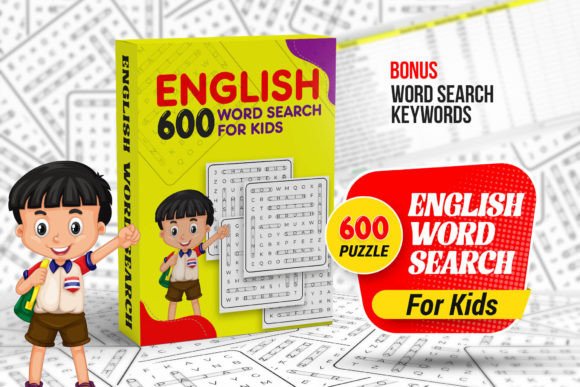
This category sits between DIY and pre-made books. A high-volume digital collection, such as the 600 English Word Search Collection for Kids, provides editable JPG images that KDP publishers can drop directly into Canva, InDesign, or any publishing software. Instead of spending days creating puzzles, you get a ready-made library of age-appropriate puzzles themed around English vocabulary. The sheer quantity—600 puzzles—supports large activity books or multiple volumes without repetition. The benefit is a blend of time savings and creative flexibility: you control the interior design, cover, and overall branding while the puzzle grid and word list come pre-validated. For non-publishers, a parent or educator could also use such images to print custom activity sheets at home, though the real strength is in commercial use.
When a Bulk Digital Collection Becomes the Smartest Move
For KDP publishers who need to ship consistent, themed activity books quickly, a large word search collection answers several pain points at once. Instead of juggling licenses or piecing together free puzzles, you work from a single source with a unified style. The 600 English Word Search Collection, for instance, is built with kids in mind—word lists feature everyday English terms, animals, foods, colors, and common objects that align with early elementary vocabulary. This age-targeting removes guesswork; you avoid accidentally including words that are too obscure or complex. Commercial-ready JPG images mean you skip the formatting nightmare of aligning grids in your layout tool. Drag, resize, and the puzzle retains clarity. That kind of efficiency directly reduces time-to-market, which is valuable when you publish activity books seasonally or for trending topics.
Consider a realistic example: A KDP creator building a 100-page “Summer Fun Activity Book for Kids Ages 6-8.” Half the pages might be word searches. Using a collection of 600 puzzles, you can sort by theme (animals, summer objects, travel) and select exactly the ones that fit. Compare that to using free generators: each puzzle would need to be generated, tested, copied into a design program, and possibly adjusted for print quality. The time difference can be 20–30 hours versus 3–5 hours of layout work. The tradeoff, of course, is the upfront cost of the collection, but that cost is often recouped through faster publishing and higher-quality books.
Important Factors to Weigh When Selecting a Word Search Resource
No single solution works for everyone. Asking a few targeted questions can clarify which direction suits your context best.
- Volume and frequency of need. Are you making one activity book, a series, or a handful of classroom printouts? High volume favors bulk collections; low volume may be fine with free tools.
- Age and skill level targeting. A resource designed for kids aged 6–8 will look different from one for 10-year-olds. Check word length, grid size, and direction (forward only vs. diagonals). The 600 English Word Search Collection caters to early learners, so it fits lower elementary grades. If your audience is older, you would need to verify complexity.
- Format and editing flexibility. Editable files (layered PSDs, PPTXs, or high-res JPGs in a standard resolution) make inserting puzzles into different book sizes straightforward. If a collection only offers PDFs with restricted editing, your design freedom narrows.
- Commercial licensing. This is a make-or-break factor for KDP. A license must explicitly allow use in printable products sold online. Many free resources do not. The 600 English Word Search Collection is marketed directly to KDP publishers, so the commercial intent is built in.
- Uniqueness vs. convenience. A completely custom-crafted puzzle set is undeniably unique, but at scale, most kids would not notice or mind that the same word list appears in another activity book because the surrounding context, design, and cover matter as much. Convenience often outweighs the pursuit of 100% uniqueness.
Understanding the Role of Word Search Puzzles for Kids in KDP Activity Books
Word searches often serve as “filler” content in activity books, but the best publishers treat them as core content. A well-designed puzzle page, paired with complementary word tracing, coloring, or match-the-picture activities, creates a cohesive learning experience. With a large pool of puzzles like the 600 English Word Search Collection, you can assemble thematically coherent books—for example, “My First 100 Animals Word Searches” or “Everyday Vocabulary Puzzle Fun.” The variety lets you build product lines without reusing the same puzzle grids repeatedly, which is a common complaint in low-effort activity books that recycle puzzles. Additionally, because JPG images can be previewed easily, you can scan a collection before purchase to ensure the puzzles look clean, the fonts are kid-friendly, and word overlaps feel natural, not forced.
One nuance that experienced creators consider is the balance between puzzle density and white space. Kids need room to circle letters without visual clutter. A collection that provides puzzles in a clear, open-grid style with a dedicated word bank area is simpler for children to navigate. Many cheaper resources cram letters tightly or use difficult-to-read typefaces, which can frustrate young solvers and lead to negative reviews. When evaluating any word search product for kids, zoom in on a sample and imagine a 6-year-old’s experience. That small visual test can prevent larger quality issues down the line.
When Might You Need an Alternative?
Bulk digital collections are not a universal fix. If your project demands a very specific, niche vocabulary—say, historical terms from a particular event or characters from an original story you wrote—you may need to create puzzles from scratch or hire a designer. In those cases, the 600 English Word Search Collection’s general English word lists might not match your exact theme. Similarly, if you are a parent wanting just three or four puzzles for a birthday party, spending on a commercial collection would be overkill; a quick free generator or a single printable packet is more economical.
Another scenario is when you require puzzle data in an editable text format rather than images. Some KDP tools work better with vector formats or live text layers so you can change fonts or colors across all puzzles instantly. If a collection only provides flattened JPGs, that limits advanced customization. However, for most designers using Canva or similar platforms, high-resolution JPGs are more than adequate. The convenience of not having to futz with text boxes often speeds up production.
Educators and after-school program coordinators might also weigh whether they need reproducible rights for multiple classrooms. A digital purchase used for printing hundreds of copies across a school might require a different license tier. Checking the license terms—whether it covers unlimited prints within a single book or wider distribution—is always prudent.
Making a Decision That Aligns with Your Time, Budget, and Goals
The ideal path depends on the intersection of three practical constraints: budget, available time, and the volume of puzzles you need. For a KDP publisher aiming to release a professional activity book within a month, the efficiency gained from a ready-made collection often justifies the cost many times over. The 600 English Word Search Collection for Kids specifically addresses the needs of publishers who want to bypass the creation phase and focus on content curation, design, and marketing. Its 600 unique puzzles provide enough material to support multiple books, spin-off titles, or seasonal variations. For a parent designing a personalized learning binder for a single child, free tools or a modest printable pack may be sufficient.
When comparing these paths side by side, think not only about the initial output but also about reuse. A purchased puzzle collection with commercial rights becomes an ongoing asset. You can return to it months later for a new book idea without additional cost. In contrast, generating 50 puzzles manually locks that time investment into one product only. Over the long run, the asset-like nature of a large puzzle collection often yields a higher return for frequent publishers.
Ultimately, word search puzzles for kids remain a versatile, engaging format that bridges entertainment and learning. The method you choose to source them—from crafting a few on a quiet afternoon to integrating a 600-puzzle library into your next KDP bestseller—should reflect your end user’s experience and your own workflow realities. No option is universally superior; what works for a full-time activity book creator may not suit a weekend scrapbooker. By weighing volume, customizability, licensing, and age-appropriateness, you can confidently select a word search resource that makes sense for your project while keeping the young solver at the center of the experience.