How Log Book Templates Transform Record Keeping Across Industries and Personal Projects
Recording information consistently is one of those quiet disciplines that separates organized professionals from those who constantly scramble to reconstruct details from memory. Whether tracking vehicle mileage, documenting laboratory experiments, monitoring patient symptoms, or maintaining equipment service histories, the structure provided by log book templates eliminates the friction that often causes people to abandon their documentation habits altogether. The difference between a blank notebook and a thoughtfully designed template is the difference between a pile of scattered notes and a searchable, actionable archive.
Why Structure Matters More Than You Might Expect
Human beings are remarkably good at convincing themselves they will remember details later. Research on memory reliability consistently demonstrates otherwise. A well-designed log book template functions as an external cognitive scaffold, capturing information at the moment of occurrence when recall is still accurate. The psychological benefit is significant — when the format tells you exactly what to write and where, the mental load drops substantially. You stop negotiating with yourself about whether to record something and simply follow the framework.
Consider a maintenance technician who services twenty pieces of equipment across a facility. Without a standardized template, notes from different visits might capture completely different types of information, making trend analysis nearly impossible. With a consistent layout, patterns emerge naturally. The same principle applies whether you are tracking a child's allergy symptoms, documenting crop yields on a farm, or maintaining a pilot's flight hours. The template enforces the discipline that consistency requires.
Digital Designs That Translate Seamlessly to Physical Use
The beauty of modern log book templates designed for print lies in their hybrid utility. Creators, educators, and business owners can purchase downloadable template collections, print exactly what they need, and even customize the source files to match specific organizational requirements. The KDP-ready formats mean these designs have already been optimized for professional printing standards, eliminating the trial-and-error that typically accompanies self-published record-keeping materials.
Having editable source files in multiple formats — AI, EPS, SVG, PDF, PPT, and JPG — provides flexibility that static printed books cannot match. A small business might start with the standard template, realize they need an additional column for client signatures, modify the vector file in Adobe Illustrator, and have their customized version printed locally or uploaded to Amazon KDP as their own branded notebook. This adaptability makes template collections particularly valuable for entrepreneurs who want to create niche log books for specific audiences without starting from a blank artboard.
The Advantage of No-Bleed A4 Formatting
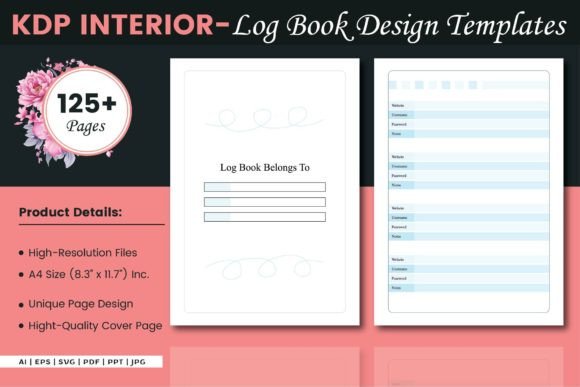
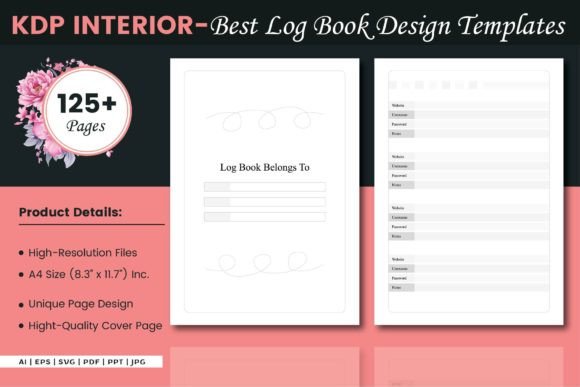
The specification of A4 size at 8.3 by 11.7 inches with no bleed requirements is not arbitrary. No-bleed designs mean every element stays safely within the printable area, preventing the frustration of trimmed headers or lost margin notes. For users printing at home on standard office printers, this compatibility removes the technical barriers that often accompany professional design files. The 125-page count provides enough capacity for substantial record keeping across months or even a full year, depending on the logging frequency, while remaining slim enough to staple-bind or fit into a spiral binding machine.
Who Benefits Most from Structured Logging Systems
The range of potential users for well-designed log templates extends far beyond what most people initially imagine. Each group brings distinct requirements that shape how the templates function in practice.
Educators and researchers use log books to maintain experimental records, track student progress, or document field observations. The sequential nature of a bound log book, with dated entries and consistent formatting, provides the chronological integrity that academic and scientific work demands. In research contexts, a properly maintained log book can serve as legal documentation for patent claims or regulatory compliance.
Healthcare professionals and caregivers rely on symptom trackers, medication logs, and vital sign charts to monitor patient conditions over time. A template that prompts for time of day, dosage, observed effects, and relevant contextual notes transforms scattered jottings into medically useful records that can inform treatment decisions.
Fleet managers and drivers maintain mileage logs, fuel consumption records, and vehicle inspection reports. Templates designed for this purpose often incorporate space for odometer readings, route details, and expense categorization that simplify tax preparation and operational analysis.
Hobbyists and makers, from gardeners tracking planting dates and harvest yields to homebrewers documenting fermentation temperatures and tasting notes, find that templates elevate their pursuits. The act of systematic recording often deepens engagement with the hobby itself, revealing patterns that enhance skills and outcomes.
Small business owners across industries use inventory logs, visitor registers, equipment maintenance schedules, and employee training records. Customizable templates allow them to brand these documents while maintaining professional standards that impress clients and satisfy auditors.
What Makes a Log Book Template Truly Functional
Effective templates share several characteristics regardless of their specific application. Clarity of purpose comes first — each page should immediately communicate what information belongs where, using visual hierarchy to guide the eye naturally through the entry process. Adequate writing space matters more than most designers realize; templates that cram too many fields onto a single page become frustrating to use in practice. Logical grouping of related information helps users complete entries efficiently, while date fields and sequential numbering support later retrieval.
Durability considerations also influence design choices. Templates intended for field use — on construction sites, in agricultural settings, or during outdoor research — benefit from layouts that remain legible even when filled out in less-than-ideal conditions. Larger handwriting spaces and high-contrast printing accommodate these real-world constraints.
Creative Applications That Extend Beyond Traditional Logging
The versatility of log book templates invites applications that designers may not have originally considered. A wedding planner might repurpose a guest registration template as a keepsake book where attendees record advice for the couple. A Dungeon Master running tabletop roleplaying games could adapt an equipment log template to track player inventory and campaign events. Language learners transform vocabulary logs into personalized dictionaries organized by theme and difficulty.
The extra cover page included in many template collections supports these creative uses beautifully. A custom cover transforms a generic interior into something that feels purpose-built for the specific application, whether that is a family recipe book, a travel journal documenting visited destinations, or a fitness tracker monitoring workout progression.
Integrating Templates into Daily and Weekly Routines
The most beautiful template in the world delivers zero value if it sits unused. Successful implementation typically involves anchoring the logging habit to an existing routine. A driver who fills out the mileage log while their coffee brews each morning, or a nurse who completes patient documentation immediately after each consultation, builds consistency through association. The template design should support this behavioral integration by being quick to complete — measured in seconds rather than minutes for routine entries.
Some users find it helpful to keep the log book physically visible as a reminder. A clipboard hanging near the equipment being monitored, a notebook placed prominently on the desk, or a binder stored with the supplies being tracked all leverage environmental cues to support the habit. The professional appearance of well-designed templates makes them items users want to display rather than hide, which subtly reinforces consistent use.
Customizing Templates Without Professional Design Skills
The inclusion of editable source files in vector formats like AI and EPS means that users without formal design training can still make meaningful modifications. Simple adjustments — adding a company logo, changing column headers to match internal terminology, adjusting the order of fields to match workflow — are achievable with basic software familiarity. More ambitious users might combine elements from different templates, creating hybrid layouts that serve niche purposes no pre-made template addresses directly.
PPT format inclusion is particularly thoughtful for users who work primarily in office environments. PowerPoint's familiarity makes it accessible for text edits and layout tweaks, while the resulting files can still produce professional-quality printed output. This lowers the barrier to customization substantially compared to requiring Adobe Creative Suite proficiency.
Print Quality Considerations for Professional Results
The high-resolution interior files ensure that text remains crisp and lines print sharply even on demanding output devices. For users uploading to Amazon KDP, this print-ready quality eliminates the common rejections that result from low-resolution source materials. For local printing, the PDF format preserves vector sharpness while being universally compatible with print shop workflows.
Paper choice interacts with template design in ways worth considering. Heavier paper stocks resist bleed-through when users write with fountain pens or markers, while lighter stocks keep multi-year log archives manageable in weight and thickness. The no-bleed design accommodates either choice without sacrificing layout integrity, since all content remains within standard printable margins.
The availability spanning six format types — AI, EPS, SVG, PDF, PPT, and JPG — means users can select the version that matches their workflow rather than converting between formats and potentially introducing errors. A designer refining the template professionally might work in AI, while someone needing a quick print would grab the PDF, and a user wanting to embed a page image in a website or presentation might use the JPG or SVG.
Building a Library of Purpose-Specific Record Keeping Tools
Organizations and individuals who maintain multiple log types often discover synergies between them. An equipment maintenance log that tracks repair history informs purchasing decisions about replacements. A visitor register that shows peak traffic times helps optimize staffing schedules. When templates share a consistent visual language — similar typography, compatible layouts, matching color schemes — these cross-referencing benefits become more accessible. The cohesive appearance also projects professionalism when multiple logs are presented together to clients, inspectors, or auditors.
Subscribing to template creators who regularly release new designs allows users to expand their documentation toolkit as needs evolve. What begins as a simple mileage log might grow to include expense tracking, inventory management, and customer relationship records, all maintaining design consistency that reinforces brand identity and operational standards.