Editable 2024 Safety Crisis Plan Journal
What Is the Editable 2024 Safety Crisis Plan Journal?
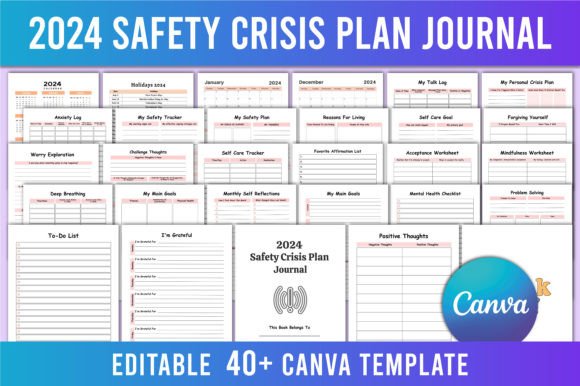
A safety crisis plan isn’t just a static document—it’s a living tool that can help you navigate overwhelming moments with clarity and compassion. The Editable 2024 Safety Crisis Plan Journal offers exactly that, in a flexible, modern format designed for real life. Delivered as a set of 43 print‑ready Canva templates, this journal combines daily, monthly, and moment‑by‑moment mental health support inside a beautifully structured 8.5”×11” design. Because every page is fully editable in Canva, you can personalize prompts, colors, and layouts before printing or using digitally.
Inside, you’ll find much more than a basic planner. The journal integrates a 2024 calendar, holiday list, and monthly planner from January to December with dedicated therapeutic exercises. Pages like My Personal Crisis Plan, Safety Tracker, Anxiety Log, Reasons For Living, Forgiving Yourself, and Talk Log transform abstract self‑care into concrete daily actions. Mindfulness worksheets, a Worry Exploration section, Deep Breathing guides, and a Mental Health Checklist round out a resource that feels both structured and gentle. You receive high‑resolution PDF, JPG, and PNG files (300 DPI, CMYK, no bleed) so you can print at home, use at a copy shop, or share with clients—whatever fits your workflow.
Why Different Audiences Care About This Resource
Not everyone approaches a crisis planning journal with the same goals. A therapist might value clinical‑adjacent structure and customization, while a busy parent wants immediate, no‑fuss prompts that fit into a chaotic day. The Editable 2024 Safety Crisis Plan Journal respects these differences because it’s built to be reshaped.
Mental health professionals and coaches often look for reliability and client‑ready presentation. The CMYK 300 DPI specification means the printed pages won’t surprise them with off‑color boxes or fuzzy text. Since the templates are editable, a counselor can add their practice logo, rephrase a worksheet to match a specific therapeutic approach (like DBT or ACT), or remove sections that don’t align with a client’s needs. For educators and school counselors, the ability to simplify language for teenagers or create a streamlined classroom version is a significant advantage. They aren’t starting from scratch; they’re adapting a proven framework.
For creative entrepreneurs, wellness bloggers, and Etsy sellers, the journal offers more than personal use—it’s a commercial asset. Because you receive a direct editable Canva link, you can rebrand, repurpose, and even resell the designs as part of your own digital product line (check licensing terms). The 43 varied templates reduce design hours, giving you a PLR‑style head start. Presentation matters here: beautifully arranged pages like Favorite Affirmations List, Self Care Goal, and Monthly Self Reflections are visually consistent, so your brand maintains a polished look with minimal effort.
On the other side, individuals using this journal purely for self‑care—whether they’re navigating anxiety, grief, or just building resilience—often prioritize ease and emotional safety. The fillable prompts lower the barrier to entry. You don’t need to be an artist or know Canva deeply; the templates work as print‑and‑fill pages straight from the PDF. For a beginner stepping into mental health journaling for the first time, having a pre‑organized Challenge Thoughts worksheet or a ready‑made Acceptance Worksheet can feel reassuring rather than overwhelming.
For Absolute Beginners and Self‑Care Seekers
If you’ve never created a safety plan before, staring at a blank notebook can be paralyzing. The journal’s guided structure walks you through essential steps: identifying triggers, listing coping strategies, naming supportive people, and documenting professional contacts. The Safety Plan page itself follows a logical flow that mirrors clinical best practices without using intimidating jargon. The Reasons For Living spread, with its gentle, open‑ended space, invites reflection without demanding lengthy writing. You can simply print the PDF, hole‑punch it, and build a binder that grows with you. The inclusion of a 2024 holiday list might seem like a small detail, but for someone whose mental health dips during holidays, seeing those dates flagged in advance helps with proactive coping.
For Experienced Practitioners and Coaches
Clinicians often juggle generic worksheets that don’t perfectly fit a client’s voice. With full Canva editing, you can swap out generic placeholder text for culturally relevant examples or client‑specific calming phrases. A therapist working with adolescents might inject more visuals and reduce text density on the Anxiety Log. A life coach might combine the My Main Goals pages with the Self Care Tracker to help a client see how daily habits support larger ambitions. Because you can export both print‑ready and digital formats, remote sessions become smoother: email the PDF for the week, or screen‑share the Canva file during a telehealth call.
For Creators, Bloggers, and Small Business Owners
If you sell printable planners, wellness bundles, or mindset tools, the editable Canva link functions like a ready‑to‑brand kit. You can adjust the color palette to match your seasonal branding, add your website URL, or embed a QR code linking to your coaching services. One often‑overlooked advantage is the 300 DPI CMYK color profile; when you send these to a professional printer, the results stay crisp and vibrant, which matters for product photography and customer satisfaction. The I’m Grateful To‑Do List or Positive Thoughts pages can easily become lead magnets or newsletter freebies if you restyle them minimally. However, always double‑check usage rights to ensure you stay within allowed commercial boundaries.
For Educators and Community Workers
A school counselor might not need all 43 pages. By removing irrelevant sections, they can build a lean, 12‑page student booklet focused on Deep Breathing, Problem Solving, and My Talk Log. The monthly reflections become a structured check‑in tool, while the Mental Health Checklist helps students self‑screen in a low‑stakes way. Because the templates are designed for 8.5”×11”, they fit standard school printers and copiers without cropping weirdness—no bleed means no trimming disasters.
Key Features That Matter Most, Depending on Your Priority
Different people evaluate the same product through different lenses. Here’s how the journal’s specifications translate into real‑world value based on what you care about most.
Ease of Use: If you dread complicated software, the PDF and PNG files are ready on arrival. Print immediately, no design skills needed. The editable Canva link offers a free‑tier friendly way to tweak text if you want, but you aren’t forced to use it.
Flexibility: The 43 separate templates mean you can create multiple versions for different purposes—a basic crisis plan for a binder, a full coaching workbook, a slimmed‑down anxiety tracker. The variety of page types (Mindfulness Worksheet, Forgiving Yourself, Favorite Affirmation List) lets you curate what’s relevant.
Presentation and Professionalism: Design‑conscious users will notice the thought behind consistent layouts, readable fonts, and printer‑friendly CMYK colors. For those presenting to clients or selling as a digital product, crisp 300 DPI resolution ensures the final output doesn’t look homemade in a negative way.
Cost and Speed: Instead of hiring a designer or buying multiple separate printables, one bundle delivers a full year’s framework plus specialized mental health tools. For a small business owner, the hours saved on layout alone can justify the investment. For a consumer, it’s the difference between buying five different journals versus one cohesive system.
Long‑Term Usefulness: The journal spans 2024, but the core exercises—Anxiety Log, Problem Solving, Self Care Tracker—aren’t date‑restricted in a way that makes them obsolete. You can reuse the worksheets annually by editing the calendar pages, making it a sustainable resource rather than a one‑year‑only product. The Thank You Page and Notes pages also add a touch of completion without waste.
Who Should Use This Crisis Plan Journal?
If you’re still unsure whether this journal fits your situation, ask yourself a few honest questions. Do you feel more supported when mental health tools are already designed for you, or do you need full creative control from the start? If you lean toward wanting a blueprint that you can gently modify, this editable set is a strong match. Are you planning to use the pages as a personal lifeline, a professional resource you share with others, or both? The hybrid nature of the product—printable yet customizable—makes it easy to straddle those roles.
Those who benefit most include:
- People who want a structured but warm self‑care routine without journaling from scratch every day.
- Therapists, social workers, and coaches looking to supplement sessions with editable, take‑home materials.
- Creators who sell wellness printables and need a versatile starting point that respects print quality.
- Beginners exploring crisis planning who appreciate guided frames and concrete steps.
- Educators and youth advocates building accessible emotional health tools.
On the other hand, if you want a highly bespoke planner and you’re comfortable building pages from a blank canvas in Canva, you might only need this as inspiration rather than as a full purchase. If you’re looking primarily for a digital app experience with interactive checkboxes and notifications, a printable and Canva‑based solution might feel too manual for your taste—though the digital fill capability partially addresses this.
The Editable 2024 Safety Crisis Plan Journal isn’t about adding more to your plate; it’s about having a ready‑to‑adapt companion that respects where you are right now. Whether you print a single page at 3 a.m. or build an entire branded coaching workbook over a weekend, the same thoughtful architecture supports you. That blend of structure and flexibility is what makes it a genuinely helpful resource for such a wide range of people—each finding their own reason to keep it close.