Writing Practice Alphabet Workbook
Most alphabet tracing books land in a child’s hands without much thought about sequence, frustration points, or how a simple dotted line can shape early writing confidence. The Writing Practice Alphabet Workbook takes a different route. It is designed not just to entertain a preschooler for a few minutes, but to build letter formation habits that stick. For parents, early childhood educators, and content entrepreneurs building educational resources, this workbook represents a carefully structured tool where every page serves a developmental purpose.
What sits inside the workbook and why it matters for early pen control
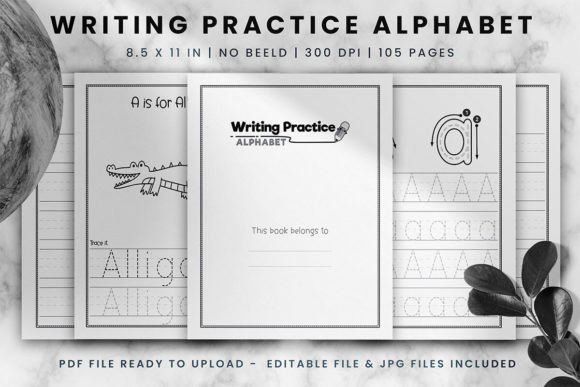
This is a 105-page PDF formatted at 8.5×11 inches with no bleed, making it immediately suitable for home printing or commercial use on platforms like Amazon KDP. Each letter from A to Z receives dedicated space—four full pages per letter—that covers uppercase, lowercase, and word tracing anchored by illustrated animals beginning with the studied letter. The real differentiator lies in the directional arrows. Children do not simply connect dots; they are guided along the correct stroke path each time. That small design decision reduces the likelihood of ingrained reversals and awkward grip later on.
The Writing Practice Alphabet Workbook includes a welcome page that sets a positive tone, followed by the core tracing exercises. The repetition across four pages per letter is not accidental. It allows for distributed practice, a well-known factor in motor learning. A child might do one page on Monday, revisit the same letter on Wednesday, and by Friday write a simple animal name like “ant” or “bear” with markedly better control. For the adult guiding the process, the structure does the heavy lifting of lesson planning.
Strategic value beyond a simple tracing book
A resource like this can function as a quiet anchor in a broader early literacy plan. When a parent or teacher looks at a shelf of workbooks, the decision often comes down to novelty versus sustainability. Many bright, busy books overwhelm with stickers and sound effects but leave little room for mastery. The Writing Practice Alphabet Workbook strips the process down to its essentials, yet builds in enough visual support—through animal illustrations—to maintain a child’s interest without sensory overload.
From a strategic standpoint, anyone who needs to produce consistent handwriting outcomes over a three- to six-month period can treat this workbook as a core asset. Instead of printing random worksheets from different websites, which often feature inconsistent letter shapes or stroke orders, the adult can rely on one unified source. This consistency is particularly valuable in early years settings where multiple caregivers might work with the same child. Everyone follows the same path from arrow to dashed line, reducing contradictory instructions.
When to introduce directional tracing into a learning routine
Timing matters more than most people assume. Handing a three-year-old a pencil and expecting neat letter formation often backfires because fine motor readiness isn’t there. The workbook becomes a strategic tool around age four to five, or whenever a child shows interest in writing their name or copying letters seen in books. At that point, using a page or two from the Writing Practice Alphabet Workbook two to three times a week can outperform daily drills that lead to fatigue and avoidance.
Many families use these pages in short morning blocks, perhaps five to ten minutes, while an older sibling does homework or while a parent prepares breakfast. The predictable layout means even a child who is not yet reading can understand what to do after a short demonstration. Over time, the child internalizes the direction of each stroke. This reduces the need for constant verbal correction—a point that matters a great deal for maintaining a calm learning atmosphere.
Using the workbook to support broader learning goals, not just letter shapes
Tracing letters is low-level if it remains an isolated activity. The real leverage comes when an adult connects the writing to sounds, vocabulary, and visual discrimination. As the child traces uppercase “A” and lowercase “a,” the accompanying animal word—ant, for example—can become the start of a short conversation. “What sound do you hear at the beginning of ant?” Without adding any extra pages, the Writing Practice Alphabet Workbook provides a reliable springboard for phonemic awareness. The animal images are not decoration; they are retrieval cues that help a child associate letter form with sound and meaning.
Over a full alphabet cycle, a child builds a personal set of animal words that can later be used for simple spelling attempts. An educator or parent who documents the child’s progress might notice that the letter “e” was particularly difficult, even though “b” and “d” were not confused. This kind of observation, possible because the four-page structure gives enough data points, enables targeted support without buying an additional intervention resource.
Planning for progressive skill development with a single resource
The workbook can be approached in phases. In a first pass, the child focuses only on uppercase letters, using the directional arrows heavily. The adult may even use a highlighter on the dashed lines to increase contrast. In a second pass, the lowercase pages become the priority, with attention to sizing and sitting letters on the baseline. A third pass might revisit selected letters to write the animal names, this time with very light tracing support. By the time a child reaches that third stage, the same book that once seemed repetitive now serves as a progress record.
This layered approach aligns with what occupational therapists often recommend: learn gross formation, refine, then apply in context. The Writing Practice Alphabet Workbook holds all three stages in one PDF, so there is no need to purchase a separate practice pad at each step. For families on a budget or classrooms with limited supplies, that consolidation is meaningful.
How content entrepreneurs and publishers can position the workbook
Beyond direct use with children, this workbook is packaged for commercial viability. The included PDF is print-ready at 300 DPI with no bleed, and the Bonus includes editable original files in AFpub format plus JPG files. That means someone who runs a small publishing brand or creates low-content books for KDP can adapt the design, add their own branding, and bring it to market quickly. The trim size—8.5×11 inches—is standard and removes a common formatting headache for new publishers.
Strategic decision-making here involves choosing the right audience segment. The workbook can be positioned as a homeschool staple, a travel-friendly car activity book printed on demand, or a supplementary resource within a larger preschool bundle. Because the interior is already structured for learning, the publisher does not need to invent an educational framework from scratch. They can focus on cover design, marketing copy, and niche targeting while letting the content do its job.
Publishing decisions: format, platform, and differentiation
Uploading to Amazon KDP requires adherence to specific guidelines. The no-bleed PDF eliminates the risk of content being trimmed off, and the 105-page count sits comfortably within acceptable spine width for paperback creation. Publishers should verify that the animal illustrations are to their standards and that the directional arrows remain clear after printing at home or through POD. A test print is a practical step before full release. The bonus AFpub files also allow translation into other languages, which expands market reach without recreating the entire layout.
One risk to monitor is over-personalization. While the editable files are powerful, altering the stroke order arrows or changing the dashed line patterns could undermine the pedagogical integrity. If the goal is to sell a workbook that parents trust, retaining the original tracing design is often the smarter brand decision. Customers who notice that letters are formed incorrectly will leave reviews that damage long-term credibility. Thoughtful use of the editable elements means adjusting covers, adding a logo, or perhaps inserting a progress tracker, not redesigning core letter formation.
Common pitfalls when using letter tracing workbooks too casually
The biggest mistake is treating the workbook as a standalone babysitter. When a child traces without any oversight, they may practice the wrong tripod grip, apply too much pressure, or ignore the directional arrows altogether. The arrows are effective only if an adult draws attention to them in the first few sessions. Pointing and saying, “Start at the dot, follow the arrow,” establishes a mental model. Without that, the child traces randomly and the Writing Practice Alphabet Workbook loses much of its value as a corrective tool.
Another risk is moving too fast. Because there are four pages per letter, an eager parent might ask a child to complete all four in one sitting. This volume is intended for spacing, and the design supports that by offering variety—page one might be large uppercase tracing, page three might be a mix of uppercase and lowercase with a word. Compressing the work into a single session often leads to sloppy formation and a negative emotional association. The adult’s role is to guard the pace.
Maintaining motivation without external rewards
Many workbooks bundle in sticker charts or certificates. This one deliberately keeps the environment minimal, relying on the inherent satisfaction of seeing a completed letter and associating it with an animal. Adults can build motivation through conversation rather than prizes. After a child traces “C” and “cat,” a quick chat about cats or drawing a cat in the margin can deepen engagement. This approach keeps the focus on the writing process itself, which is more sustainable than a reward system that fades once the stickers run out.
For professionals who use this workbook in occupational therapy or tutoring contexts, note-taking in the margins becomes a quiet coaching tool. A small arrow drawn to reinforce a tricky stroke, a checkmark beside a neatly formed letter—these subtle signals build internal motivation. The clean layout provides plenty of white space for such annotations.
Integrating the workbook into a long-term early literacy framework
This is not a resource to sprint through and discard. The Writing Practice Alphabet Workbook fits into a year-long arc that includes oral storytelling, sound games, and eventually simple reading. Writing and reading reinforce each other, but only if handwriting practice does not become drudgery. Because the workbook limits itself to alphabet tracing and word-level practice, it leaves room for other language-rich activities. A typical week might involve two workbook pages, one read-aloud session focusing on letter sounds, and one playful writing activity like forming letters in sand or with play dough.
From a planning perspective, mapping the 26-letter journey onto a calendar creates natural checkpoints. A month can be devoted to letters A through F, ensuring a child feels competent with the first six before moving on. Deliberate pauses at letters that represent multiple sounds, like vowels, allow the adult to introduce the short vowel sounds in context. The animal names help—cat, egg, igloo, octopus, umbrella—reinforcing those short sounds through familiar and easily pictured words.
When to reprint or reuse the workbook across siblings or cohorts
Being a downloadable PDF, the workbook can be printed multiple times for personal family use or in-class duplication, depending on the license terms from the original seller. This reusability shifts the cost-benefit calculation significantly. A single purchase can support several children over successive years, making it a durable asset for homeschooling families or small daycare centers. Keeping a master print copy in a binder with plastic sleeves allows children to use dry-erase markers for extra practice before committing to paper, which can reduce paper waste and giving a trial-run layer to more hesitant writers.
When preparing materials for a new school year, a center director might print the entire Writing Practice Alphabet Workbook once and then bind copies for each classroom assistant. Because the directional arrows are embedded in the design, even a less experienced assistant can guide children correctly simply by following the page. This reduces training time and maintains instructional quality across different staff members.
Making informed decisions about letter formation methodology
Not all arrow systems are equal. Some worksheets use multiple starting points that confuse children. This workbook appears to follow a consistent top-start approach for uppercase letters and a logical stroke sequence for lowercase, which aligns with major handwriting programs. Before committing to wide use, an educator might test a few pages with a small group of children to observe whether confusion arises on complex letters like “k” or “y.” The four-page structure gives enough material for such a pilot without additional resources.
If a particular child struggles with a specific letter, the adult should resist the urge to keep repeating the same page until it’s perfect. Instead, use the bonus JPG files to isolate and enlarge problematic letters for large-format tracing on an easel or whiteboard first. This gross motor warm-up can shift a child’s understanding of the stroke pattern before returning to the workbook’s smaller scale. The combination of the print PDF and digital extras creates flexibility not found in a static printed workbook bought off the shelf.
Long-term results for children and the adults guiding them
Children who use the Writing Practice Alphabet Workbook thoughtfully tend to develop more automatic letter formation. Automaticity frees up cognitive resources for spelling and composition later on. Instead of remembering how to write an “s,” the child can focus on the word they want to express. This is the real long game—handwriting as a servant to thinking, not a bottleneck. For the adult, having a single, well-organized resource means less time hunting for supplemental materials and more time observing and supporting the child’s progress.
The workbook’s design also communicates a subtle lesson to the adult: good teaching tools are clear, repeatable, and adaptable. By studying the progression from dashed letters with arrows to independent word tracing, an educator internalizes a template for designing other skill-building sequences. That insight can influence how they approach teaching numbers, shapes, or even early drawing. In this way, the workbook becomes more than a product—it acts as a professional development tool disguised as a children’s resource.
Choosing the right moment and environment for effective practice
Even the best workbook underperforms if the setting works against focus. A kitchen table cluttered with toys, a television in the background, or a time of day when the child is hungry will erode any gains the directional arrows might offer. The adult’s strategic choice is to designate a brief, calm period—perhaps after a snack and before active play—and to sit alongside the child for the first two minutes of each session. Physical presence signals importance and allows gentle corrections to grip and posture before they become habits.
Lighting also matters. The dashed lines require visual clarity, and a dimly lit corner will cause eye strain and potential disengagement. Positioning the printed page on a slight slant board or clipboard can improve wrist extension and comfort. These environmental tweaks are low-cost but high-impact, and they multiply the workbook’s effectiveness far beyond what a digital screen-based tracing app could achieve.
Ultimately, the Writing Practice Alphabet Workbook succeeds when it’s used with intention—when the adult understands why there are four pages per letter, why the arrows face a certain direction, and how each session fits into a larger picture of literacy and motor readiness. Without that intention, it’s just another stack of paper. With it, the workbook becomes a reliable path from unsteady scribbles to the moment a child writes their own name with quiet pride and correct letter formation.