Mastering the $6,000 Emergency Fund Savings Challenge
Financial uncertainty arrives without warning. A sudden car breakdown, an unexpected dental procedure, a leaking roof—these moments test not just your resourcefulness but the structure of your financial life. An Emergency Fund Savings Challenge turns an abstract goal into a deliberate, trackable process. The $6,000 target printed across 48 precise increments isn’t merely a number; it’s a blueprint for replacing anxiety with readiness. For professionals, freelancers, and anyone who has felt the weight of an unplanned expense, this kind of tool bridges the gap between wanting security and actually building it.
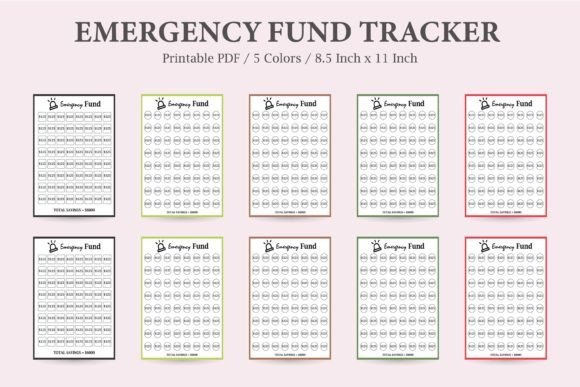
What sets this approach apart is how it transforms saving from a passive hope into an active, visual commitment. When you hold a physical tracker—a clean, minimalist sheet with 48 boxes, each representing $125—you’re not staring at a spreadsheet. You’re interacting with a promise. The very act of filling in a box creates a small but genuine dopamine hit, reinforcing the behavior you want to cement. It’s a tangible emergency cash reserve system that respects the psychology of progress.
Why a Physical Emergency Savings Fund Tracker Still Matters
In a world of apps and automated round-ups, a printable Emergency Money Planner might seem almost nostalgic. Yet its power lies precisely in its analog nature. Digital notifications are easy to dismiss. A sheet pinned to your wall or tucked inside a budget binder stays visible, serving as a quiet, persistent nudge. Each time you pass it, you’re reminded of your emergency savings goal without needing to unlock a phone. That constant, low-level presence keeps your commitment from fading between paychecks.
Moreover, the manual process of shading a box connects you to your money in a way that automatic transfers often fail to do. You’re not just watching a number climb on a screen. You’re physically marking your territory, claiming progress step by step. For visual learners and those who thrive on tactile reinforcement, this turns a dry financial task into a satisfying ritual. The design itself—professional, uncluttered, ink-friendly—means it doesn’t scream “novelty.” It fits alongside serious financial documents, whether you’re a small business owner tracking a cash buffer or a blogger teaching financial literacy to your audience.
Deconstructing the $6,000 Goal: 48 Boxes, Countless Lessons
The structure of this Emergency Fund Savings Challenge is deceptively simple: save $125 in 48 separate increments to reach $6,000. But inside that framework lies remarkable flexibility. You aren’t locked into a weekly pace. One user might fill a box every Friday after setting aside a portion of their paycheck. Another, perhaps a freelancer with fluctuating income, might knock out three boxes in a good month and pause during a lean one. The tracker doesn’t judge; it just counts.
Consider how this adapts to real life. If you commit to bi-weekly deposits aligned with your pay schedule, you complete the challenge in under two years. If you’re aggressive and aim for a box every three days, you finish in under five months. The 48-box format gives you a clear endpoint without dictating the rhythm. This makes it a genuine budget emergency fund tool rather than a rigid program that collapses at the first obstacle. You set the cadence; the tracker captures the evidence.
When a Crisis Fund Tracker Saves More Than Money
The true value of a dedicated emergency fund reveals itself during the moments that otherwise trigger debt. A pet emergency requiring immediate surgery. A car accident where the deductible alone is $1,000. A dental implant that insurance covers only partially. These aren’t hypotheticals—they’re the kind of expenses that studies show derail a significant percentage of households each year. Having $6,000 in a crisis fund doesn’t make the stress disappear, but it strips away the financial panic. You make decisions based on need, not on the desperate search for liquid cash.
This is where the Crisis Fund Tracker earns its keep. By defining what constitutes a “true emergency” from the start, you build a mental wall around the money. It’s not for a weekend trip or a new gadget. It’s for the broken water heater in February. The tracker’s label—Emergency Fund—serves as a psychological gatekeeper. When you’ve spent weeks coloring those boxes, you’re far less likely to raid the fund for an impulse because you’ve encoded the sacrifice visually.
Breaking Down the Printable’s Practical Strengths
When you first download the PDF, you immediately notice the thoughtful restraint. At 8.5 by 11 inches, it prints on standard paper without cropping issues. The five color versions aren’t decorative excess; they allow you to choose a palette that suits your home office aesthetic or simply to differentiate accounts if you’re managing multiple goals simultaneously. The minimalist design ensures the ink cost stays negligible, even if you print several copies for long-term use or to share with family members.
The 48-box grid is laid out with generous space, making it easy to write dates or initials inside each completed box. That small detail matters. Recording the date you filled a box transforms the tracker into a financial diary. Months later, you can look back and see when you had a particularly strong saving streak—or when life forced a pause. It becomes a record of persistence, not just a coloring sheet.
- Clarity: No confusing charts or complex instructions. The goal and the step amount are immediately obvious.
- Portability: Slips easily into a binder, a desk drawer, or a budget journal, keeping your emergency savings goal visible in the context of your broader financial plan.
- Low-tech reliability: Never runs out of battery, never requires an update, and never sells your data. It’s a passive financial security tracker that works as long as you use it.
Who Gains the Most from This Financial Security Tracker?
While anyone can benefit, certain groups will find the Emergency Fund Savings Challenge unusually well-suited to their lives. Freelancers and gig workers, whose income streams can vary 30% or more month to month, need a visual anchor. A $6,000 cushion specific to emergencies means a slow-payment client doesn’t force a choice between rent and a critical repair. The tracker gives them a non-judgmental way to contribute irregular amounts while still seeing cumulative progress.
Small business owners and entrepreneurs operate in similar territory. Revenue ebbs and flows, and a personal emergency fund separate from business capital prevents a dip in sales from becoming a personal crisis. Educators, coaches, and financial bloggers can use the printable as a teaching tool, offering clients or students a concrete method to build a money emergency fund without overwhelming them with theory. Even professionals with steady salaries benefit by turning a vague “we should save more” into a defined, finishable project.
When the $125 Increment Fits—and When to Adapt
For many, $125 per box strikes a sweet spot. It’s large enough to feel substantial—you know you’ve earned that shaded square—but small enough that most households can manage it at least once a month. That said, real-world use demands honesty. If $125 consistently strains your budget, the printable doesn’t force rigidity. You could create a custom rule: every $125 saved earns one box, even if it takes two smaller deposits to get there. You could also start with a shorter-term goal and work up to the full $6,000 later. The tracker is a servant, not a master.
The same flexibility applies to the timeframe. I’ve seen people use this as a year-long challenge, setting aside around $500 a month to finish comfortably. Others blast through it in six months during a period of reduced expenses. The key is that the physical tracker accommodates both extremes without requiring any reconfiguration. You color when you can, and the momentum keeps you from quitting entirely.
Realistic Limitations to Keep in Mind
No single tool fixes everything. A printable emergency cash reserve tracker doesn’t automatically generate the income needed to fill it. If your budget genuinely has no slack, the first step is addressing income or non-emergency expenses before committing to a $6,000 target. The tracker also demands a degree of self-discipline; it won’t nag you the way an app with push notifications might. If you’re someone who forgets paper exists once it’s filed away, pairing this with a recurring calendar reminder becomes essential.
Also recognize that $6,000, while substantial, may not represent a full three-to-six-month expense reserve for higher-cost areas. This challenge works best as a dedicated emergency fund for specific, large, unexpected costs—the “crisis” layer below the broader safety net. For many, completing this tracker becomes the springboard to then building a more extensive savings buffer. Think of it as Phase One: handle the sudden shocks. Phase Two: protect against income loss.
Blending the Challenge into a Cohesive Budget Emergency Fund Strategy
To get the most from this Savings for Emergencies printable, integrate it with your existing money systems. Open a separate high-yield savings account specifically labeled “Emergency Fund.” Each time you accumulate $125, transfer the money and shade the box. The physical act of moving funds and marking progress wires your brain to see the cause and effect. If you run a zero-based budget, allocate a line item for “Emergency Fund Box Fill” and treat it with the same seriousness as your rent.
Another effective tactic involves tracking your “emergency avoidance” rate. Notice how many times you consider using the fund for something non-essential, then pause because of the visual record. These near-misses are victories. They prove the tracker is doing its secondary job: strengthening your financial decision-making muscles. Over time, you’ll likely find that your ability to distinguish between wants and genuine crises sharpens.
Long-Term Value: Beyond the $6,000 Milestone
Once the final box is filled, the journey isn’t over—it evolves. That completed Emergency Fund Savings Challenge sheet becomes a trophy and a reference point. Frame it or store it with your financial records. In the future, when you face a legitimate emergency and need to draw from the fund, you’ll also have a clear-eyed view of what it took to build it. That perspective often motivates a faster replenishment than if the money had accumulated invisibly.
The habits formed during the challenge—regular saving, visual tracking, and defining true emergencies—transfer seamlessly to other financial goals. You might create a similar tracker for a home down payment, a vehicle fund, or even a “sabbatical” account. The method scales. And because the design is minimal and professional, you can print multiple versions without feeling like you’re cluttering your space with childish gimmicks.
Is This the Right Emergency Money Planner for Your Journey?
If you’ve struggled to make financial safety concrete, if you’ve read all the advice about having an emergency fund but never quite believed it could apply to your income level, this printable offers a different entry point. It doesn’t lecture. It doesn’t require a spreadsheet or a fintech app. It just asks you to commit to one box at a time. For visual processors, hands-on planners, and anyone tired of purely digital solutions, the Emergency Fund Savings Challenge can become the quiet catalyst that shifts your financial reality.
Choose the version that matches your environment—maybe the crisp black-and-white for a business planner, or the softly tinted variant that doesn’t clash with your home decor. Print it. Place it where you’ll see it every day. And when you fill that first box, notice how it feels. That feeling, repeated 47 more times, builds a $6,000 shield. More importantly, it builds the muscle memory of a saver, which will outlast any single emergency and underpin decades of financial confidence.